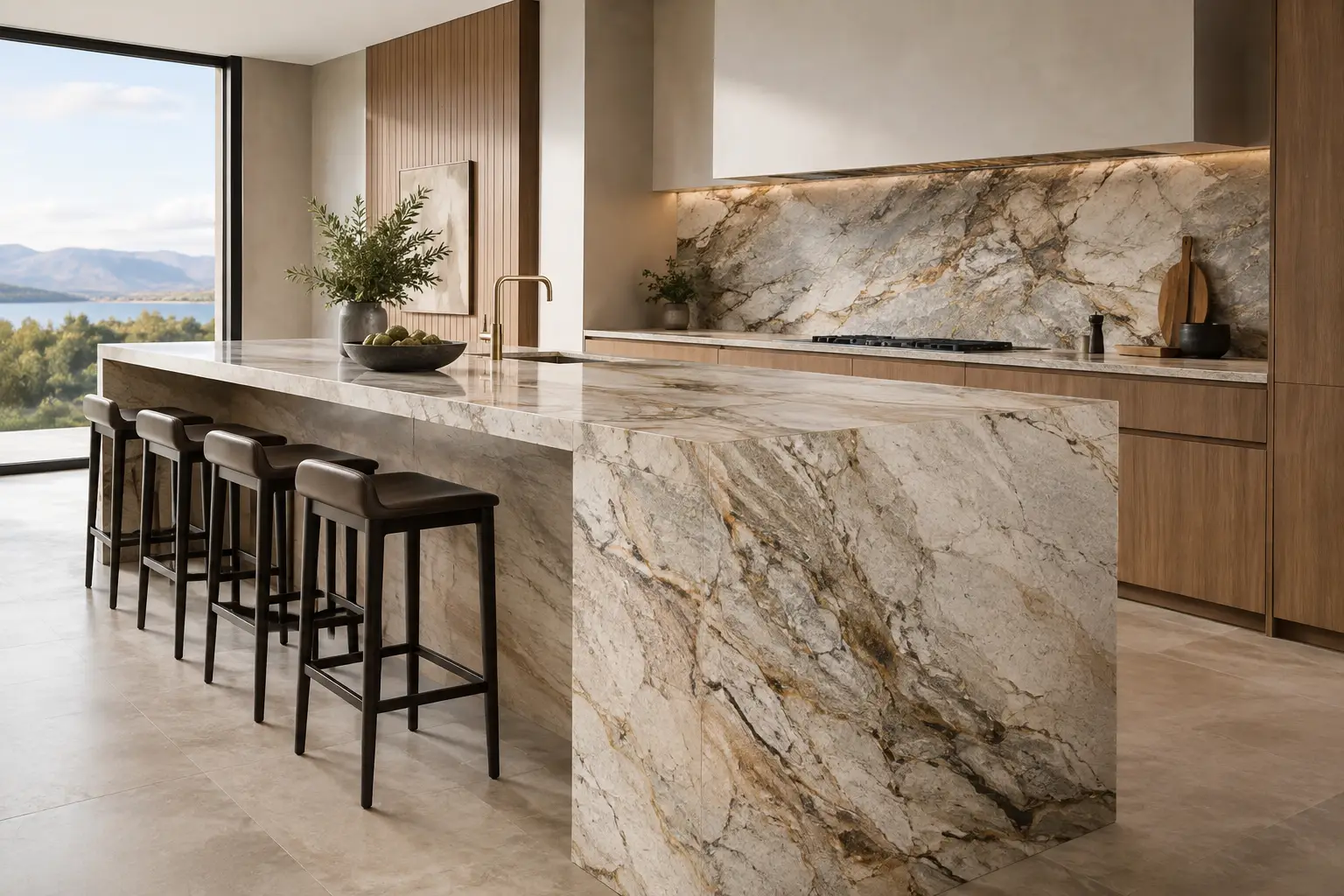
A kitchen island can occupy the centre of a room, yet it does not need to shout to be memorable. A single slab of natural stone, chosen for its veining, depth and quiet shifts in colour, can set the entire material direction for a home. It gives a space something manufactured surfaces cannot replicate: a story formed over time, revealed differently in every slab.
For architects, designers and homeowners alike, that individuality is the point. Natural stone is not a uniform finish selected from a small sample. It is an architectural material with variation, movement and character that deserves to be seen at slab scale before it becomes part of a finished space.
Why natural stone changes a room
Stone has visual weight. It can anchor a pared-back kitchen, add softness to precise contemporary joinery, or bring drama to a hospitality interior without relying on excessive decoration. Marble may introduce elegant veining and luminosity. Quartzite can offer pronounced movement with a more crystalline appearance. Granite often brings grain, depth and enduring presence, while onyx can create a remarkable focal point where its translucency is used thoughtfully.
The value is not simply that the material looks luxurious. Natural stone creates contrast against timber, brushed metal, plaster and painted joinery. It adds detail that remains interesting at close range, while reading as a strong, composed gesture from across the room.
Because every block is different, no two projects will resolve in exactly the same way. That makes stone especially compelling for spaces intended to feel personal rather than prescribed.
Selecting the slab, not just the species
It is tempting to begin and end with a material name: white marble, dark granite or green quartzite. Yet the species is only the starting point. The individual slab is where the design decision becomes real.
Within one stone family, the background tone may shift from warm white to cool grey. Veins may be fine and linear, broad and expressive, or concentrated in one area. Some slabs have open movement that suits a generous island or feature wall. Others carry a more even pattern that may sit beautifully across a vanity or a series of smaller surfaces.
Viewing actual slabs helps a project team assess proportion, direction and character together. It also allows for practical conversations early in the process: where joins may fall, whether bookmatching would suit the application, and how the stone will sit beside cabinetry, flooring and fixtures.
This is why a showroom-led selection process matters. A small sample can indicate colour, but it cannot reveal the presence of a full slab. For a statement surface, that difference is significant.
Let the application guide the choice
The most expressive material is not automatically the right material for every location. A richly veined marble may be perfect for a powder room vanity, fireplace surround or feature wall, where its visual character can take precedence. A kitchen benchtop calls for a broader consideration of household habits, finish, edge details and the way the surface will be used each day.
Quartzite is often considered for kitchens because of its distinctive mineral movement and its suitability for demanding settings, but each stone should still be assessed on its own merits. Granite can bring a grounded, architectural quality to high-use surfaces. Onyx is generally better treated as a feature material, particularly when lighting can reveal its exceptional depth.
There is no single hierarchy of stone. The right choice depends on the visual ambition of the project, the location, and the level of natural variation the client wants to embrace.
Natural variation is part of the design
Fissures, mineral deposits, tonal shifts and veining are not flaws to be designed away. They are evidence of how the stone was formed. Some clients are drawn to a serene slab with restrained detail; others want dramatic movement that becomes the defining feature of the room. Both approaches are valid, provided expectations are clear from the beginning.
A successful specification treats variation as a design input. If a slab has a bold area of movement, it may be positioned deliberately on the front of an island, behind a basin, or through the centre of a wall panel. If the project calls for continuity, slab sequencing and vein direction should be considered before cutting begins.
This is also where craftsmanship and communication matter. Designers can use the stone’s natural features to create a composed result rather than leaving those decisions until the final stages of the project.
Designing with scale and restraint
Natural stone is powerful, but it does not need to appear everywhere. Often, one considered application has more impact than repeating the same material across every surface.
An island clad in an exotic quartzite may become the heart of an open-plan kitchen, balanced by quieter stone on the perimeter. A marble vanity can bring a sense of ceremony to a bathroom when paired with simple tapware and warm lighting. In a commercial setting, a carefully selected stone reception desk or bar front can establish a strong sense of arrival without overworking the interior.
Scale changes how a stone reads. Fine veining that seems subtle in a showroom may become more animated across a long benchtop. Conversely, a large-format feature wall can give dramatic material enough room to breathe. Looking at photographs is useful, but standing in front of a full slab is the more reliable way to understand its rhythm.
Colour is only one part of the decision
Clients often arrive with a colour in mind, perhaps a clean white kitchen or a deep green bathroom. That is a useful starting point, but the most successful stone selections usually go further. Undertones matter. A white marble may carry cream, blue-grey or soft gold through its background. A dark granite can contain flecks that pick up nearby timber or metal finishes.
Consider the room’s natural light as well as artificial lighting. Stone can look markedly different in morning sun, under warm downlights or alongside a cool-toned painted wall. Bringing cabinetry samples, flooring, tile selections or paint swatches to a slab viewing helps reveal these relationships before decisions are fixed.
For projects with a strong architectural palette, stone can either provide calm continuity or offer intentional contrast. Neither is inherently better. The question is what role the material should play in the overall composition.
Practical care without losing the romance
Natural stone is enduring, but it is not indifferent to use. Different materials have different properties, and the appropriate care routine should be discussed for the selected stone and application. Some stones may require sealing, while acidic foods, oils, cosmetics and strongly pigmented products can call for prompt attention depending on the surface.
This should not discourage a natural stone specification. It simply asks for an honest match between material and lifestyle. A family kitchen used constantly will have different priorities from a sculptural powder room in a carefully detailed residence. Patina may be welcome in one project and less desirable in another.
The aim is not to make stone behave like a synthetic product. It is to choose it with knowledge, then care for it in a way that respects its natural character.
A more considered way to choose stone
For premium residential, hospitality and commercial projects, stone selection is most effective when it happens early enough to influence the design. It can inform joinery proportions, splashback heights, lighting positions and even the quieter materials around it.
At Moonstone, the emphasis is on viewing hand-selected slabs and finding material with a character that belongs in the project. For clients visiting the Auckland showroom, an appointment offers time to consider actual slabs alongside plans and finish samples, rather than making a significant material decision from a thumbnail image.
Bring the dimensions, the surrounding palette and a clear sense of how the space will be lived in. Then allow the stone to do what exceptional material does best: show you a possibility the drawing alone could not yet reveal.