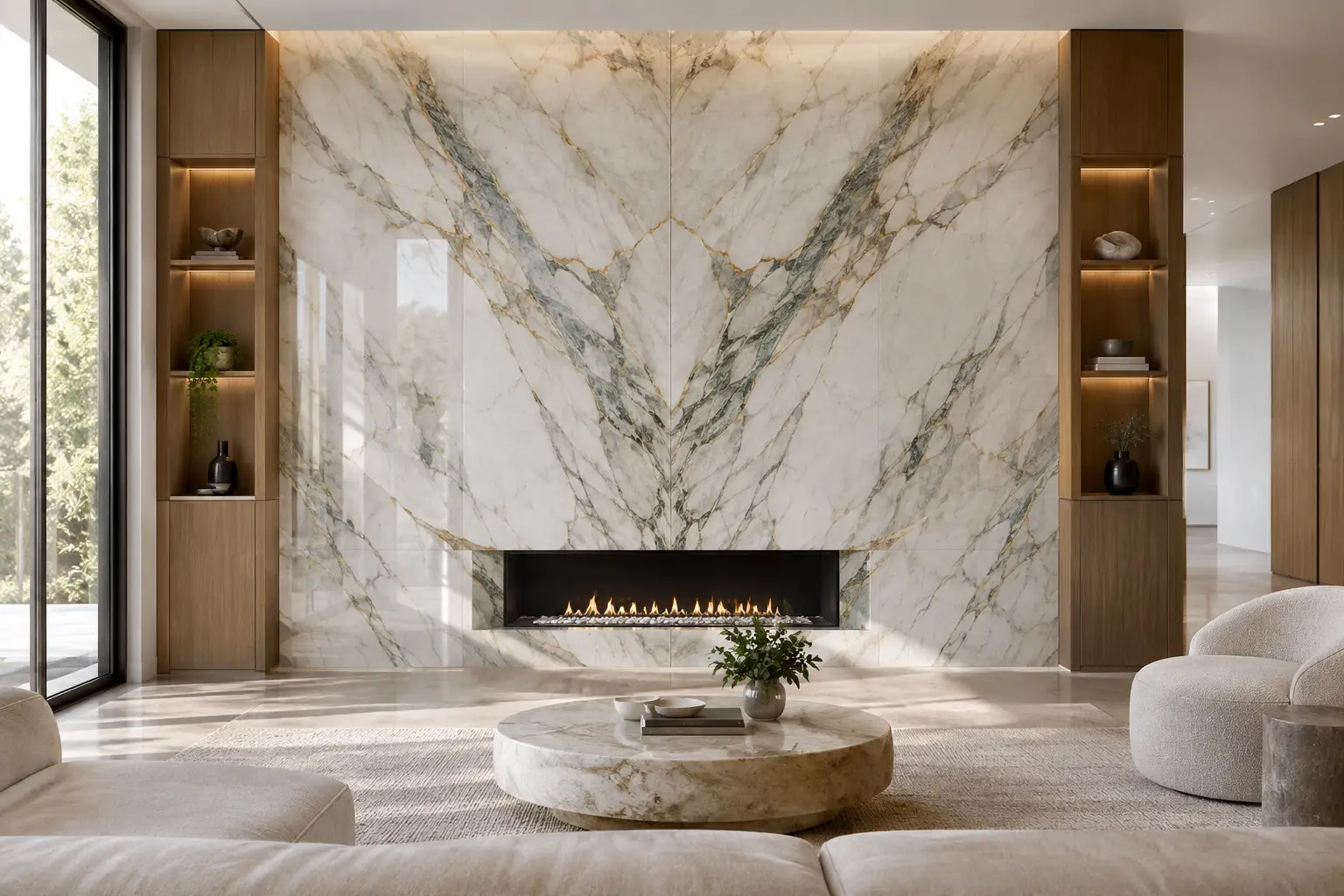
A single marble slab can be extraordinary. Open it along its natural vein line, however, and it becomes something more architectural: a composed field of movement, colour and depth. Bookmatched marble wall panels use two adjoining cuts of the same slab, set as mirror images, to create this effect. The result is not a pattern imposed on stone, but the stone’s own character revealed at scale.
For a dramatic bathroom, a hospitality entry or the wall behind a fireplace, bookmatching gives natural marble a presence that few other materials can replicate. It asks for careful decisions early in the design process, particularly around slab selection, panel layout and lighting. When those decisions are considered together, the finished wall feels intentional rather than merely decorative.
What makes bookmatched marble wall panels distinctive?
Bookmatching begins with the way a slab is cut. Two sequential faces are opened and polished, much like the pages of a book, then positioned beside each other so that the veining mirrors across the join. Depending on the stone, the centre line may create a soft, fluid symmetry or a bold, almost geological composition.
This is why marble with pronounced movement is so often selected for feature walls. A quiet white marble with fine, linear veins can create a restrained and elegant result. A richly figured Calacatta, Breccia or green marble can become the focal point of the entire room. Neither approach is inherently more successful. The right choice depends on whether the architecture calls for calm continuity or a more expressive material statement.
Natural variation is central to the appeal. Unlike a repeated printed surface, every bookmatched arrangement is specific to the slabs selected. Changes in tone, crystalline detail, fissures and veining are part of the material’s identity. They should be understood as features of genuine stone, not details to be designed away.
Start with the wall, not the sample
A small marble sample can indicate colour, but it cannot convey the full movement of a bookmatched wall. The composition only becomes clear when actual slabs are viewed as a pair and considered at their intended scale. For this reason, slab selection should happen while the wall dimensions and surrounding finishes are still flexible.
A wide wall may allow a pair of generous panels to read as one sweeping composition. A narrow vanity backdrop might benefit from a more concentrated central movement. If the space requires multiple panels, the layout becomes more complex: the order of each piece, vein direction, joint locations and any cut-outs all influence the final image.
It is also worth considering where the eye will meet the stone. In an entry, the wall is often experienced from a distance, where strong movement can feel sculptural. In a powder room, users stand close to the surface, so finer detail and the placement of a mirror or wall light carry greater weight. The material should respond to how the space is used, not simply fill an available wall.
Scale changes the character of marble
A highly dramatic slab can feel perfectly balanced across a full-height wall, yet overwhelming when confined to a small niche. Conversely, a subtle marble may appear understated in a large open room but reveal remarkable depth in an intimate bathroom. There is no universal rule about how much veining is enough.
The key is proportion. Consider the height and width of the wall, ceiling line, joinery and adjacent surfaces. A bookmatched composition can be given room to lead the design, or it can be framed by timber, plaster, metal or quieter stone surfaces. Both approaches work when the relationship is deliberate.
Choosing the right marble for a bookmatched wall
Not every marble reads in the same way when bookmatched. Selection should be led by the desired visual outcome rather than a colour name alone. Stones with broad, directional veining often create a powerful mirrored effect. Those with softer clouds, mineral shading or fine tracery may produce a more atmospheric, less symmetrical composition.
Colour deserves the same attention. White and pale marble can bring luminosity to a darker interior, especially where natural light is limited. Deep green, burgundy, black or brown marbles add depth and intimacy, and can sit beautifully within timber-rich, moody palettes. Onyx and certain exotic natural stones can offer exceptional translucency and movement, though their suitability should be assessed carefully for the intended application and detailing.
Finish also changes the reading of the wall. A polished surface heightens colour and reflects light, often emphasising the drama of the veins. A honed finish has a softer, more tactile appearance and may suit interiors seeking restraint. Neither is simply a matter of preference: lighting, touchpoints and the broader material palette should guide the decision.
At Moonstone, viewing hand-selected slabs in person allows designers and clients to assess these qualities honestly. It is the most reliable way to understand the scale, natural variation and potential bookmatch of a rare natural stone before it is committed to a project.
Bookmatched marble wall panels need thoughtful detailing
The beauty of a bookmatched wall depends on precision beyond the slab itself. Panel joints are inevitable in many applications, but they can be planned to support the composition. A central join is often used as the axis of the mirror image. Additional joins should be positioned with care so they do not cut awkwardly through a significant vein or create visual interruption at eye level.
Openings need the same discipline. A tap set, wall basin, mirror, shelf, power point or fireplace aperture can alter the composition considerably. Where possible, set out these elements over a slab image before finalising their position. Sometimes a central mirror can conceal a quieter area of stone and leave the most striking movement visible at either side. In other projects, the marble itself deserves to remain uninterrupted.
Edges and returns also influence the final impression. A stone panel that wraps neatly into a reveal, niche or side wall can feel integrated with the architecture. By contrast, a poorly resolved termination can make even exceptional material feel like an afterthought. Early coordination between the designer, stone supplier, fabricator and relevant trades is essential, particularly when tolerances are tight.
Lighting should reveal, not compete
Light can either flatten marble or bring it to life. Grazing light from a wall washer may emphasise texture and movement, while even front lighting can present colour more consistently. Highly polished stone will reflect fittings and windows, which can be desirable in some settings but distracting in others.
Before selecting decorative lighting, consider its reflection in the finished wall. Warm, controlled illumination often enhances the depth of natural stone, while excessively cool or uneven light can make nuanced colouring appear harder than intended. For hospitality spaces, viewing the slab under proposed lighting conditions is particularly valuable because the wall may need to perform from day into evening.
Where bookmatching has the greatest impact
Bookmatching is most compelling where a wall has visual importance and enough clear area for the stone to read. In premium homes, this may be a double vanity wall, a full-height shower backdrop outside direct spray, a fireplace surround or the face of a kitchen island. In commercial and hospitality interiors, it can anchor a reception, private dining room, bar or lift lobby.
It does not need to dominate every room. Used selectively, a bookmatched marble wall becomes a moment of material focus, allowing surrounding finishes to remain quieter. This is often more enduring than covering every available surface in a highly expressive stone.
Practical conditions still matter. Wet-area requirements, substrate preparation, panel size, access and the location of services should be resolved with the project team. Marble is a natural architectural material with its own characteristics, so the best solution will depend on the stone selected and the demands of the environment.
A considered selection creates a lasting result
Bookmatched marble is not chosen from a catalogue image alone. It is selected through the encounter with real material: the veining that catches the eye, the pair of slabs that belong together, and the way their movement responds to a particular wall.
For projects throughout New Zealand, a showroom appointment provides the opportunity to view slab pairs at scale and discuss how they may be positioned within the design. The most memorable bookmatched walls are rarely the loudest. They are the ones where exceptional stone, thoughtful proportion and careful craftsmanship meet in a composition that feels made for that exact space.