A benchtop is often the largest uninterrupted surface in a kitchen, and one of the first materials people notice on entering the room. The decision between marble versus quartz benchtops is therefore about more than maintenance schedules or sample-board colour. It shapes the atmosphere of the entire space: whether it feels calm and tailored, richly expressive, quietly luxurious or deliberately contemporary.
Both materials can be exceptional. The more useful question is not which is universally better, but which one supports the way the room will be used, the visual language of the architecture and the character the project deserves.
Marble versus quartz benchtops: the essential difference
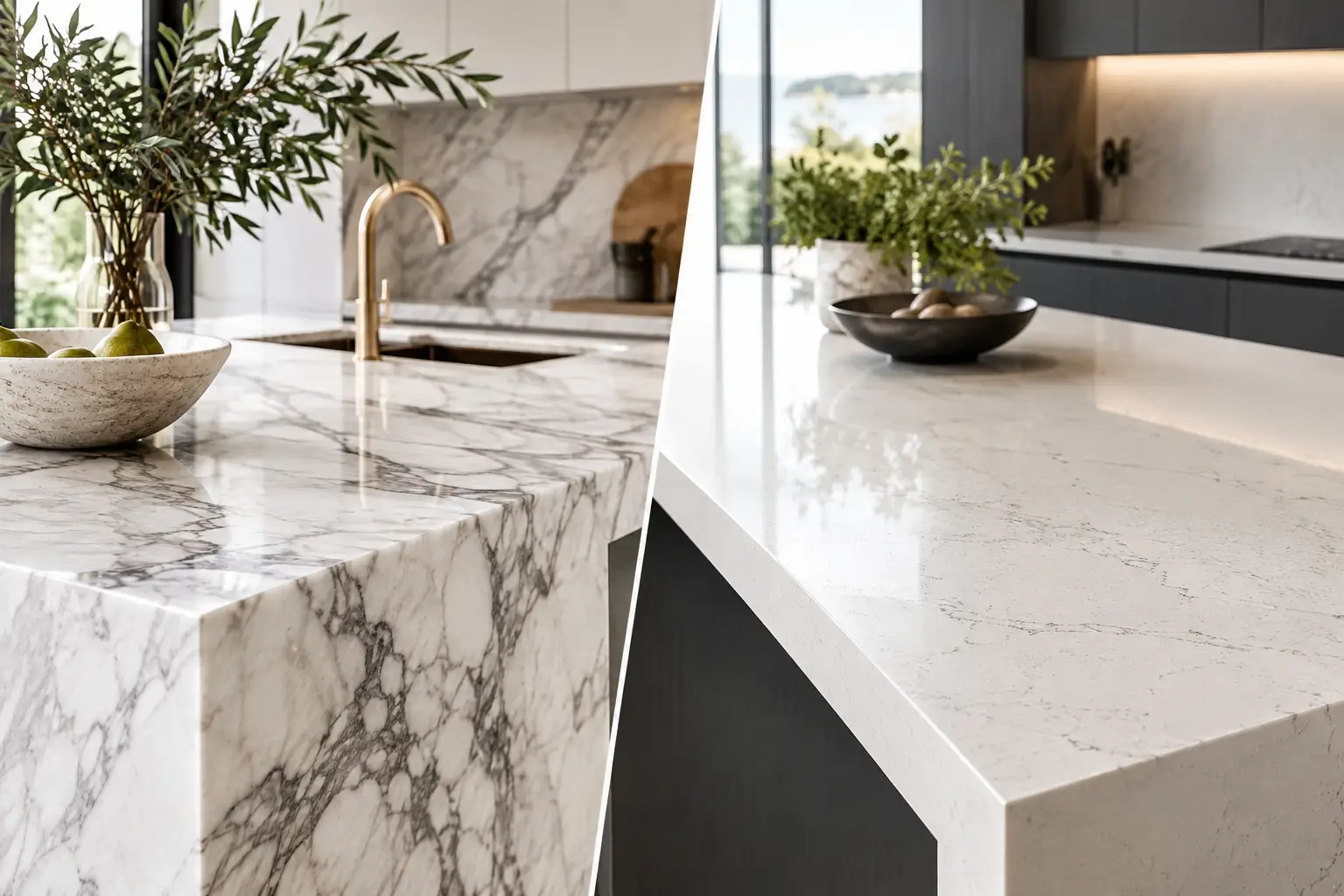
Marble is a natural stone formed over geological time. Its veining, mineral inclusions, tonal shifts and occasional movement are not applied patterns. They are intrinsic to the slab. This is why marble has such enduring presence in architectural interiors. Even within one selected variety, every slab has its own composition and character.
Engineered quartz is a manufactured surface composed largely of quartz minerals combined with resins and pigments. It offers a more controlled appearance, with consistent colour and patterning across a project. Contemporary quartz collections can range from crisp, understated whites to bold veined designs that reference natural stone.
Neither material should be judged purely from a small sample. Marble reveals its real scale through the full slab, where the direction, density and drama of its veining can be understood. Quartz should also be viewed at a meaningful scale, particularly where a veined design is being considered for a large island or continuous splashback.
The case for marble: natural variation with lasting presence
Marble is selected for feeling as much as function. It has depth that is difficult to replicate precisely: soft translucency, crystalline detail, cloud-like movement and a tactile quality that changes with the light. A carefully chosen slab can become the defining architectural material in a kitchen, bar, vanity or reception space.
For design-led homes and hospitality projects, this individuality is often the point. Rather than seeking a perfectly repeated pattern, clients may want the island to read as a singular object, with veining that travels across the surface and down a waterfall end. Marble rewards that confidence in natural variation.
Its honest character also extends to use. Marble is a calcareous stone, which means acidic substances such as lemon juice, vinegar and wine can etch its surface. Etching is not always a stain. It can appear as a softened or dulled patch in the finish, and it is especially noticeable on honed or polished pale marbles depending on the light. Like other natural materials, marble may also develop a gentle patina over time.
For some owners, that evolving surface is part of marble’s appeal. In a quieter household, a formal entertaining kitchen, a powder room or a vanity, its care requirements may feel entirely appropriate. In a busy family kitchen where the benchtop is constantly used for cooking, school lunches and serving, the decision should be made with open eyes. Marble is beautiful because it is natural, not because it behaves like an indestructible synthetic surface.
Where marble is particularly compelling
Marble is especially suited to projects where material expression matters. A softly veined marble can bring warmth and refinement to restrained joinery, while a more dramatic slab can anchor a large island in an otherwise minimal room. It can also create striking continuity when carried from benchtop to splashback or used as a full-height feature wall.
The selection process matters greatly. Two slabs with the same material name may have entirely different vein direction, background tone or degree of movement. Viewing and reserving the actual slab allows the designer, client and fabricator to plan how the stone will read across the finished application.
The case for quartz: consistency and practical confidence
Quartz surfaces offer a different kind of design value. Their controlled composition makes them a strong choice when a project needs visual consistency across several areas, when a precise colour direction is central to the scheme, or when day-to-day practicality is a priority.
Because engineered quartz is non-porous, it does not generally require sealing. It is also resistant to everyday staining when cared for according to the supplier’s guidance. This makes it well suited to hardworking kitchens, rental properties, multi-unit developments and commercial settings where ease of care is an important part of the specification.
The aesthetic range is broader than many people expect. A fine-grained quartz can sit quietly beside timber, brushed metal and painted joinery. A veined design can introduce scale and movement to a contemporary interior without asking the owner to embrace the natural variation and patina associated with marble. The right quartz need not feel flat or generic. It can be a considered architectural material in its own right.
Quartz does, however, have its own limits. It is not designed to be treated as a hot pad, and hot cookware should not be placed directly onto the surface. Colour and pattern can be highly consistent, but that consistency will not provide the one-off geological story of a hand-selected natural slab. For some projects, this is precisely the advantage. For others, it is the reason to choose marble.
How to choose between marble and quartz
Start with the role of the surface rather than a trend image. Is the benchtop intended to be a dramatic centrepiece, a refined backdrop or a dependable everyday work surface? Is the home likely to embrace signs of use, or would small changes in a natural finish become a source of concern?
Then consider the visual intent of the broader interior. Marble has a natural ability to soften clean-lined architecture and give minimal joinery greater depth. Its variation can connect a contemporary kitchen to older timber floors, textured plaster or crafted metalwork. Quartz can bring calm order to a layered scheme, particularly when the aim is a specific neutral tone or a continuous material language across multiple rooms.
Scale is equally important. On a compact benchtop, a bold marble may feel concentrated and sculptural. Across a generous island, it can become expansive and cinematic. With quartz, a larger surface can emphasise the regularity of the pattern, so slab layout and joins should be considered early. There is no substitute for seeing the material in person and discussing how its movement will be oriented.
Budget should be approached as a project question rather than a material label. Prices vary considerably according to the rarity of the marble, slab yield, thickness, dimensions, detailing and the quantity required. A quartz selection may offer greater predictability for some scopes, while a rare natural stone may justify a greater investment where the surface is central to the design. The most considered choice is the one that balances the material’s visual contribution with the realities of the project.
Care is part of the material decision
A premium benchtop performs best when its care is understood from the beginning. Marble benefits from prompt attention to spills, routine cleaning with a pH-neutral product and sensible protection from strongly acidic ingredients. Sealing can help reduce absorption, but it does not make marble immune to etching or replace thoughtful use.
Quartz is comparatively straightforward for everyday cleaning, generally requiring a soft cloth, mild detergent and water. Abrasive pads, harsh chemicals and direct high heat should still be avoided. In both cases, chopping boards, trivets and regular gentle cleaning preserve the surface and respect the material.
These are not burdens so much as different relationships with the benchtop. Marble asks for appreciation of a living, evolving finish. Quartz asks for practical care while delivering a more uniform result. The right answer depends on who will use the space and how they want it to feel years from now.
Select the slab, not just the category
The most successful stone interiors rarely begin with a generic decision to choose “marble” or “quartz”. They begin with the actual material. The warm grey in a marble background, the restrained sweep of a vein, the depth of a white quartz, or the way a surface sits beside cabinetry and flooring can change the direction of a room.
For projects using natural stone, viewing full slabs is particularly valuable. It makes the material’s variation visible and allows the selection to be made for the intended space, not from an expectation of uniformity. Moonstone’s Auckland showroom provides an opportunity to view curated marble and premium quartz surfaces in this way, with the conversation centred on the project rather than a catalogue image.
A benchtop will be touched, cleaned, leaned against and lived with every day. Choose the material whose character you will continue to appreciate after the first impression has become part of home.