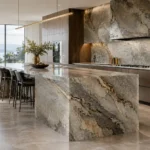
A commercial wall is often the first surface a guest, customer or tenant reads. Commercial stone cladding slabs give that surface weight, texture and a sense of permanence – but their value lies in more than visual impact. The right stone can establish a hospitality interior’s atmosphere, give a reception space a memorable identity, or bring warmth and material depth to a large-scale architectural façade.
For design-led projects, stone should be considered early. It is not a finish to be selected after the architecture is resolved. Its veining, format, thickness, finish and natural variation influence how a wall is detailed, lit and experienced from a distance and at close range.
Begin with the experience of the space
A stone-clad entrance has different demands from a restaurant feature wall, a hotel lobby, a retail fit-out or an exterior podium. Before narrowing the material selection, consider how people will encounter the surface. Will they pass it quickly, stand close to it, touch it, photograph it, or view it across a large open room?
A dramatic quartzite with exceptional movement may be ideal for a statement arrival wall where the slab can be read as a continuous composition. A quieter limestone-look surface or restrained granite may better support a refined commercial interior with layered timber, metal and upholstery. Neither approach is inherently superior. The question is whether the stone has enough presence for the architectural role it is being asked to play.
Light also changes the decision. Raking light can reveal texture and relief, while soft ambient lighting can make a richly veined stone feel calm and immersive. Where a wall faces strong daylight, examine the actual slabs at different angles. A colour that appears warm under showroom lighting may read more neutral in a bright glazed space.
Selecting commercial stone cladding slabs by character
Natural stone is not a printed pattern repeated across every panel. Marble, quartzite, granite and onyx each carry their own mineral structure, colour shifts and movement. These qualities are precisely what make natural stone such an enduring architectural material, but they require a considered selection process.
Marble for expressive interior walls
Marble brings depth that is difficult to imitate: fine crystalline detail, soft tonal variation and veining that can range from delicate to boldly directional. It is particularly compelling in reception areas, hospitality interiors, lift lobbies, bars and feature walls where its visual character is protected from heavy physical contact.
The key decision is scale. Fine veining can appear elegant in intimate rooms, while broad, sweeping movement has the presence to hold a larger wall. Where multiple slabs are required, the relationship between them matters as much as the beauty of each slab individually. A sequence can be arranged to create continuity, contrast or a deliberate central feature.
Quartzite and granite for depth and definition
Quartzite often offers dramatic natural movement alongside a denser visual structure, making it a strong choice for projects seeking expressive stone with a more geological, architectural feel. Its palette can move from pale and ethereal to richly layered with blue, green, gold or charcoal tones.
Granite can bring a different kind of confidence. Its granular patterning and natural depth suit spaces that need visual substance without relying on pronounced veining. Darker granites can create a tailored, monolithic effect; lighter selections can add texture while keeping the overall composition restrained.
Performance requirements should always be assessed in the context of the selected stone, proposed finish, wall system and site conditions. For exterior or high-contact applications, early coordination with the project architect, cladding specialist and relevant trades is essential.
Onyx and translucent stone for focal moments
Onyx is not usually chosen to quietly recede. Its translucent layers and rare colouring make it suited to carefully framed moments: a backlit bar front, a private dining wall, a boutique retail display or an exceptional hospitality feature. Lighting is integral to its effect, so the slab should be selected with the lighting design in mind rather than treated as a later material substitution.
Because onyx has such a distinctive presence, smaller areas can be more powerful than an entire room. Used with restraint, it creates a point of pause and a material signature visitors remember.
Think in slabs, not samples
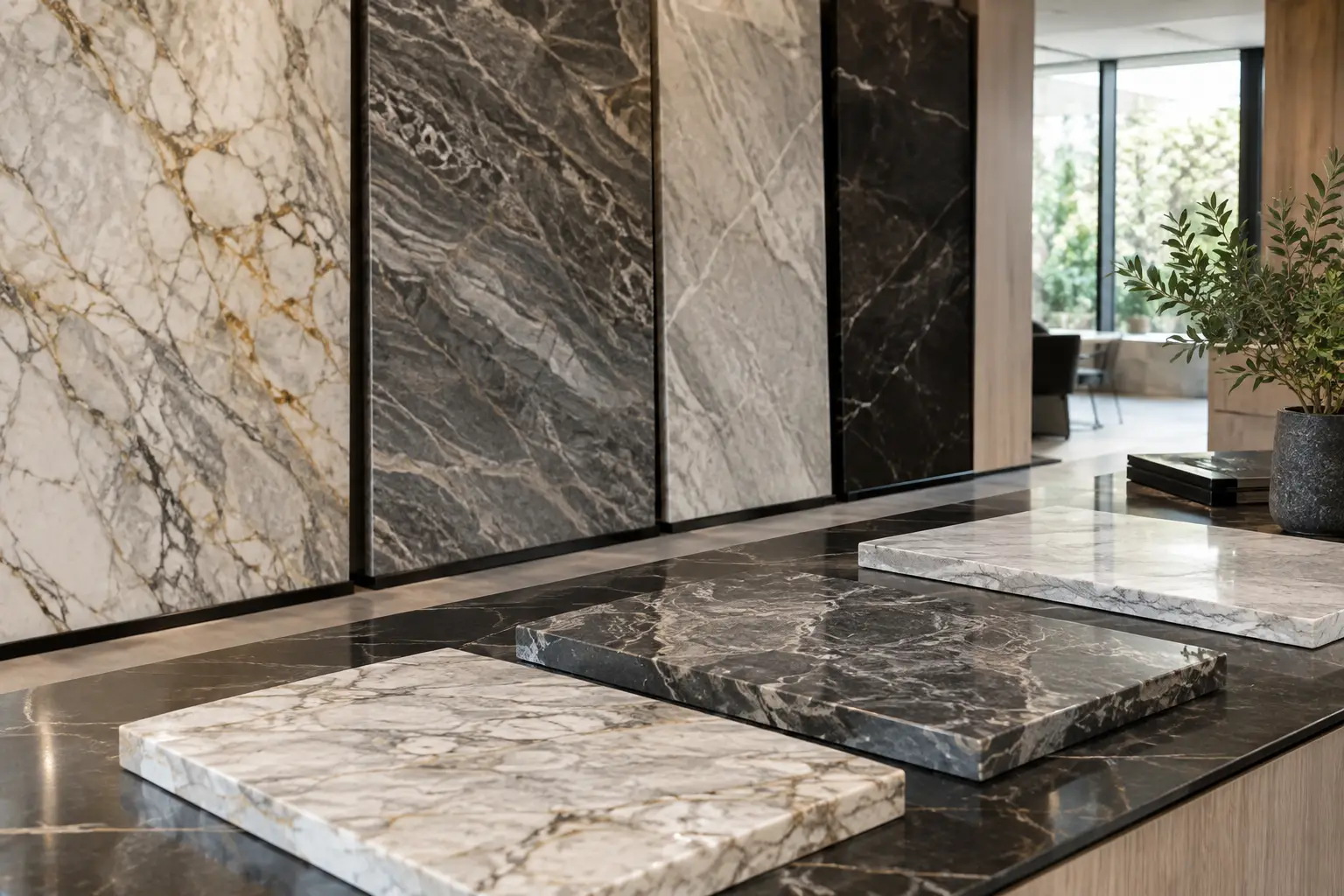
A small sample is useful for introducing colour and finish, but it cannot communicate the scale, movement or variation of a full natural stone slab. This is particularly significant with cladding. A vein that looks subtle in a sample may travel dramatically across a wall, while a broad colour shift may become a defining part of the installation.
Viewing actual slabs allows the design team to make deliberate choices about placement. The most expressive section may be reserved for the entry or behind a reception desk. Quieter pieces may sit adjacent to joinery or glazing. Directional veining can run vertically to increase a sense of height, or horizontally to lengthen a space.
Bookmatching is another consideration where the material and design call for it. Two adjoining slabs can be opened like pages of a book, allowing veins to mirror across a central joint. The result can be highly sculptural, although it is not appropriate for every stone or every commercial setting. In a restrained scheme, a continuous vein match or intentionally varied layout may feel more resolved.
At Moonstone’s Auckland showroom, viewing hand-selected slabs in person provides the clarity that samples cannot. It gives architects, designers and private clients the opportunity to select material for the actual wall, not simply approve a general colour family.
Detail the stone as part of the architecture
The most successful stone walls feel considered at every edge. Joints, returns, reveals, lighting recesses, adjacent metalwork and transitions to other finishes all affect the final impression. Stone has visual mass, and small detailing decisions can either reinforce or weaken that quality.
Large-format slabs create fewer joints and a more monolithic appearance, which is often desirable in premium commercial interiors. Yet large pieces may introduce practical considerations around handling, access, wall geometry and the selected cladding system. Smaller modules can be a deliberate design choice where rhythm, texture or easier integration around openings is needed.
Finish deserves equal attention. A polished surface reflects light and intensifies colour, particularly in richly veined marble or onyx. Honed stone offers a softer, more contemporary expression with reduced reflectivity. Textured finishes can add tactility and shadow, though they should be specified with an understanding of the intended setting and maintenance expectations.
It is also worth establishing a clear approval process before material is allocated. Confirm the desired face of each slab, vein direction, panel layout, acceptable variation and treatment of visible edges. Natural variation should be embraced, but it should never be left to chance on a design-critical wall.
Balance visual ambition with project realities
Exceptional stone creates value through character, but commercial projects also require coordination. Programme, quantities, slab yield, lead times and continuity of supply should be discussed while the design is still flexible. A rare natural stone may be ideal for a contained focal wall, while a larger application may call for a material with sufficient matching slabs available for the full scope.
This is not a reason to dilute the concept. It is a reason to direct the most distinctive material where it will have the greatest effect. A lobby may need one extraordinary stone moment rather than every wall treated alike. In a hospitality project, a dramatic cladding feature can establish identity while more understated surfaces support circulation areas.
Engineered quartz surfaces can also have a role where a consistent appearance is central to the brief. They do not replace the individuality of natural stone, but they offer a more controlled visual repeat. The right selection depends on whether the project is seeking singular movement and geological character, or a precise, uniform finish.
A material decision worth making early
Commercial stone cladding slabs are most successful when the stone is selected alongside the interior palette, lighting and wall design. Allow time to view full slabs, understand their natural variation and consider how each piece contributes to the larger composition.
The finished wall should feel inevitable: a surface with enough character to anchor the space, enough restraint to endure, and a material presence that becomes more rewarding the longer it is experienced.