A kitchen island in exotic granite is not simply a work surface. It is often the visual anchor of the room: a single, uninterrupted field of colour, mineral detail and movement that cannot be replicated exactly. Choosing an exotic granite supplier therefore comes down to more than finding a stone that looks impressive in a photograph. It is about selecting material with confidence, seeing its true character, and ensuring it belongs in the wider architecture of the project.
For designers, builders and private clients alike, the right supplier brings together a considered collection, project awareness and a showroom experience that makes natural variation easy to understand. The aim is not to make granite behave like a uniform manufactured product. It is to select the particular slab that gives a space its identity.
What Makes Granite Exotic?
The term exotic granite generally refers to granite and closely related natural stones chosen for unusual colour, pronounced movement, dramatic crystal structure or rare mineral formations. Depending on the material, a slab may carry sweeping ribbons of charcoal and white, pools of deep green, flashes of gold, or a crystalline surface that changes as light moves across it.
This distinction matters because visual impact is rarely contained within a small sample. A modest offcut might reveal a beautiful palette, but it cannot show the full composition of a three-metre island or a bookmatched feature wall. With expressive stone, scale is part of the design.
Granite is also valued for its density and suitability for hardworking architectural applications. Yet no two natural stone varieties perform in precisely the same way. Surface finish, edge detailing, intended use and maintenance expectations should all be discussed early, particularly for kitchens, hospitality spaces and high-use commercial interiors. A well-informed selection protects both the design intent and the long-term experience of the material.
How an Exotic Granite Supplier Should Guide Selection
The most useful supplier is not one that treats every slab as interchangeable stock. They should understand that a bold natural stone requires a different conversation from a quiet, consistent surface.
Start with the actual slabs
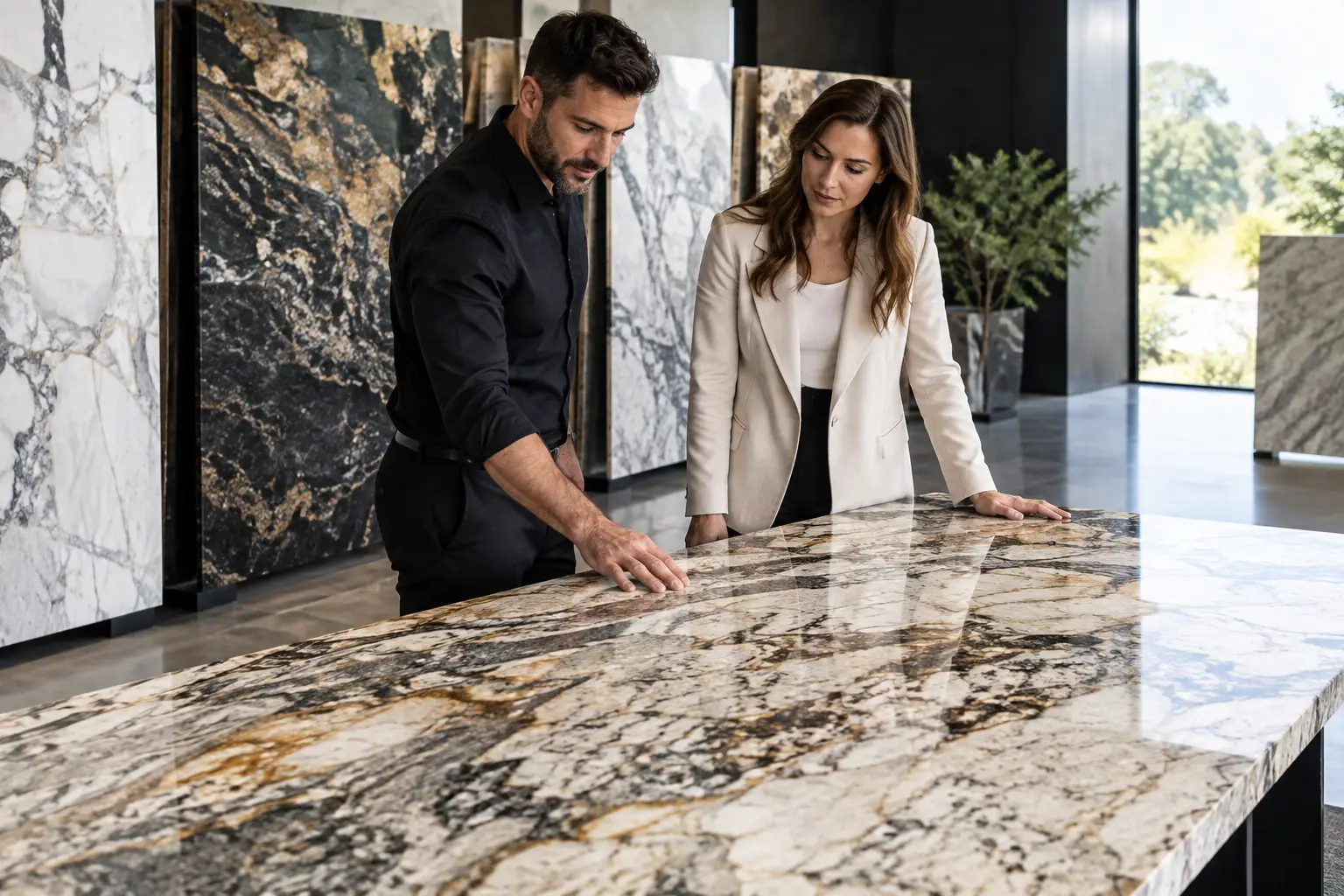
For a project centred on distinctive stone, viewing full slabs is essential. Photographs are helpful for early direction, but they can flatten depth, alter colour and hide the scale of movement. In person, you can see where a vein gathers pace, where crystalline detail catches the light, and whether a quieter area will suit a splashback, vanity or return.
This is especially important when the design calls for bookmatching. The two adjoining slabs need to be assessed as a pair, with the intended join, orientation and focal point considered before the stone is allocated. A striking mirrored pattern can feel architectural and deliberate. A poorly considered layout can lose the very movement that made the material special.
Discuss the application, not only the look
An exceptional slab should suit its setting. A richly patterned granite may be perfect for a generous island, where its movement has room to unfold, but feel visually busy across every surface in a compact kitchen. In another project, that same material may be most powerful as a fireplace surround, bar front or feature wall.
A considered supplier will ask where the stone is going, how much material is required and what other finishes sit alongside it. Cabinetry colour, timber grain, metalwork, floor tone and natural light all influence how granite reads. Dark stone can feel restrained and luxurious against pale oak, while a warm mineral palette may bring depth to brushed brass, aged bronze or softer painted joinery.
Be clear about variation and availability
Natural variation is not a caveat to be managed away. It is the reason many clients choose exotic granite. Still, it needs to be communicated plainly. A slab can include fissures, filled features, open texture, tonal shifts and mineral clusters that are entirely natural to the material. These characteristics may be visually desirable, but they should be seen and accepted as part of the selected slabs.
Availability deserves the same clarity. If a project requires multiple slabs, the supplier should help confirm whether the material can be allocated from the same batch and whether the amount available supports the planned layout. For larger hospitality or commercial work, this early coordination is particularly valuable. It keeps the design grounded in what can be supplied consistently for the project.
Questions Worth Asking Before You Select
A premium stone selection should feel inspiring, but it should also be practical. Before confirming a granite, ask to see the exact slabs proposed for your project and discuss how they may be laid out across the intended surfaces. This is the point to identify preferred areas of movement, quieter sections and any features you would rather position away from a main focal area.
It is also wise to confirm the slab dimensions against the design. A long island, for example, may require a join depending on the stone available and the planned proportions. There is no universal rule that a join is undesirable. In the right place, aligned with the grain or integrated into a considered layout, it can be unobtrusive. What matters is that it is anticipated rather than discovered late in the process.
Ask about recommended care for the particular stone and finish. Natural stone benefits from appropriate cleaning practices and, where advised, sealing. The right approach depends on the material and application, so general assumptions are less useful than advice specific to the slabs under consideration.
Finally, allow enough time for selection. Rare material can shape an interior more profoundly than a paint colour or tap finish. Selecting it after every other decision has been fixed often limits the possibilities. When stone is introduced early, the surrounding palette can respond to it with greater confidence.
Designing Around Distinctive Granite
Exotic granite works best when the design gives it a clear role. It does not always need to cover every available surface. One generous island can be more memorable than a room crowded with competing stone applications. The same principle applies in bathrooms, where a sculptural vanity or a carefully framed shower wall may carry greater presence than extensive repetition.
Consider the viewing distance. Fine crystalline detail rewards close inspection at a vanity or bar, while broad movement has greater impact on an island bench or wall seen from across a room. Lighting is equally influential. Soft ambient light may draw out depth in a dark slab, while directional lighting can highlight texture and mineral sparkle. Viewing the stone under changing light conditions helps avoid decisions based solely on a single showroom moment.
There is also value in restraint around the slab. Highly expressive granite often needs calm companions: simple joinery profiles, balanced hardware and finishes with enough texture to feel warm without competing for attention. This does not mean the surrounding scheme must be minimal. It means every material should have a purpose.
A Showroom-Led Choice for New Zealand Projects
For clients specifying rare natural stone, a showroom appointment offers a level of certainty that samples and screens cannot provide. It creates space to compare slabs, discuss quantities and consider the material in relation to the project rather than in isolation.
Moonstone NZ takes this hand-selected approach from its Auckland showroom, helping clients select distinctive granite and other exceptional surfaces for projects throughout New Zealand. The conversation can be as design-led or as practical as the project requires, from a private kitchen renovation to a coordinated commercial scheme.
The most successful stone selections begin with a simple decision: choose the slab for the space, not merely the name of the stone. When the material is viewed in full, understood honestly and placed with intention, exotic granite becomes more than a finish. It becomes the detail people remember when they enter the room.