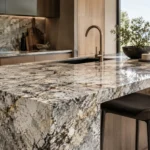
A kitchen island can be the visual centre of an entire home, yet the first stone benchtop quote often arrives as a short list of dimensions, material names and figures. The detail behind those lines matters. A considered quote gives you confidence that the stone, quantity and scope reflect the space you are designing – not simply a generic surface allowance.
For architects, designers and homeowners, the goal is not to reduce stone to a rate per square metre. It is to understand what has been allowed for, what remains to be selected, and where natural variation may influence the final result. This is particularly important when the project calls for marble with expressive veining, quartzite with crystalline depth, or a quietly refined quartz surface.
What a stone benchtop quote should make clear
A useful quote begins with the material. This may be a specific product or slab, such as a named quartz surface, or a natural stone category such as honed marble or polished quartzite. These descriptions are not interchangeable. Every natural stone has its own composition, colour range, movement and surface character. Even slabs from the same block can present differently.
Where the design depends on a particular vein, a warm undertone, dramatic movement or a rare colour, a material allowance is only a starting point. The final selection should be made from the actual slabs wherever possible. This lets the project team assess scale, direction and natural variation in relation to joinery, flooring, paint and lighting.
The quote should also identify whether the price relates to stone supply only, or whether it includes other work arranged by the relevant trade. Stone supply, template measurement, fabrication, delivery and installation are distinct parts of a benchtop project. Their inclusions can vary, so it is worth confirming responsibility early rather than assuming every line is covered by one party.
For a project with multiple surfaces, clarity becomes even more valuable. A kitchen may include an island, rear bench, splashback, butler’s pantry and window sill. A bathroom may combine a vanity top, upstand, shower niche and wall lining. Each application can affect the amount of material required, the preferred finish and the visual planning of the slabs.
Material quantity is more than benchtop area
It is natural to begin with the visible area of the benchtop. But stone is supplied in slabs with fixed dimensions, and the project must be planned around the usable area within each slab. Cut-outs, edge details, overhangs, splashbacks and the orientation of veining all influence how efficiently a slab can be used.
A large island in a highly veined natural stone may require a full slab even if its square-metre area appears modest. That is not necessarily waste. It may be the necessary allowance to preserve a continuous visual field, avoid an unwanted join, or reserve a complementary section for a splashback or adjacent surface.
Bookmatching introduces another consideration. When two slabs are opened like the pages of a book, their veining can create a mirrored composition across a feature wall, island end or fireplace surround. The effect is architectural and highly intentional, but it relies on the right slabs being available and allocated to the design. A quote should allow room for this level of planning if it is central to the concept.
Conversely, a simple, linear layout in a consistent quartz surface may use material more efficiently. Neither approach is inherently better. It depends on the desired expression, the layout and the importance of visual continuity within the finished space.
Why slab selection changes the conversation
Natural stone is not printed to a repeat. Its veins, mineral deposits, fissures, tonal shifts and occasional areas of movement are part of its identity. These characteristics should be viewed as design information, not surprises to be discovered after a selection has been made.
When reviewing actual slabs, consider how the stone will read at the scale of the room. A dense, dramatic marble may feel extraordinary across a generous island but overpower a compact vanity. A pale quartzite with gentle movement can bring depth without competing with strongly figured timber or patterned tile. Finishes matter too: honed stone tends to offer a softer, more tactile appearance, while polished finishes can heighten colour and reflectivity.
For this reason, it is helpful for the quote to distinguish between a preliminary allowance and stone that has been selected and reserved for the project. Availability changes, particularly with rare natural stone. Identifying this status avoids designing around a particular slab before it has been confirmed.
Read the scope alongside the drawings
A quote is most reliable when it is read with the latest drawings, not in isolation. Check that the dimensions correspond with the current kitchen or bathroom plan, including any changes to island length, depth, overhangs and wall linings. A small adjustment in the plan can alter slab requirements, especially when a join is being avoided or a continuous vein direction is desired.
Pay attention to the details that shape the finished edge. A standard thickness may suit a restrained contemporary kitchen, while a built-up edge can give an island greater presence. Mitred edges, curved ends, waterfall panels and integrated splashbacks each require careful material planning. These elements can be worth every bit of attention when they support the architecture, but they should be visible in the scope rather than left to interpretation.
Cut-outs also deserve confirmation. Sinks, cooktops, tap holes, pop-up power points and drainage grooves can affect both fabrication planning and the usable areas of a slab. If an appliance model has not yet been chosen, identify that early. Final specifications can influence cut-out dimensions and positioning.
The same principle applies to seams. In some designs, a join is unavoidable because of slab size, access requirements or the geometry of the space. What matters is that its likely location has been discussed. On a strongly veined stone, seam placement and vein direction can have a significant effect on the final composition.
Questions worth asking before approval
A polished quote does not replace a project conversation. Before proceeding, ask whether the material is available in the required quantity and whether you can view the slabs intended for the project. Confirm the finish, thickness and any edge treatment that forms part of the design.
It is also sensible to ask whether the quote allows for the desired layout. If the stone is intended to run from benchtop into splashback, wrap a waterfall end, or continue onto a feature wall, make sure that continuity has been considered. A drawing or marked slab layout can be valuable for complex or design-led applications.
For natural stone, ask about its inherent character rather than seeking an unrealistic promise of uniformity. Small pits, open veins, mineral variation and tonal shifts may be normal to the material. The right choice is one whose natural qualities suit the way the space will be used and the visual language of the project.
Engineered quartz can offer a more consistent appearance, which may suit projects requiring controlled repetition across several areas. Natural stone offers individuality that cannot be replicated. The decision is often less about one being preferable than about whether the interior calls for consistency, movement, rarity or a balance of all three.
Bring the design intent to the showroom
The most productive quote review happens with context. Bring plans, elevations, joinery samples, tile selections and images that communicate the atmosphere you are creating. A cabinet colour that appears neutral on screen may pull warm or cool beside a particular stone. Likewise, a slab that feels understated in a warehouse setting may become the defining material in a softly detailed kitchen.
Moonstone’s Auckland showroom provides the opportunity to view hand-selected slabs in person and discuss the material in relation to your project. For projects supplied throughout New Zealand, this early selection stage can help designers, clients and trades move forward with a shared understanding of the intended finish.
A quote should give the project a clear commercial foundation, but the best stone decisions are also visual ones. Select the slab with the drawings beside it, allow its natural character to inform the layout, and give the material enough attention to become the enduring part of the space it was chosen to be.