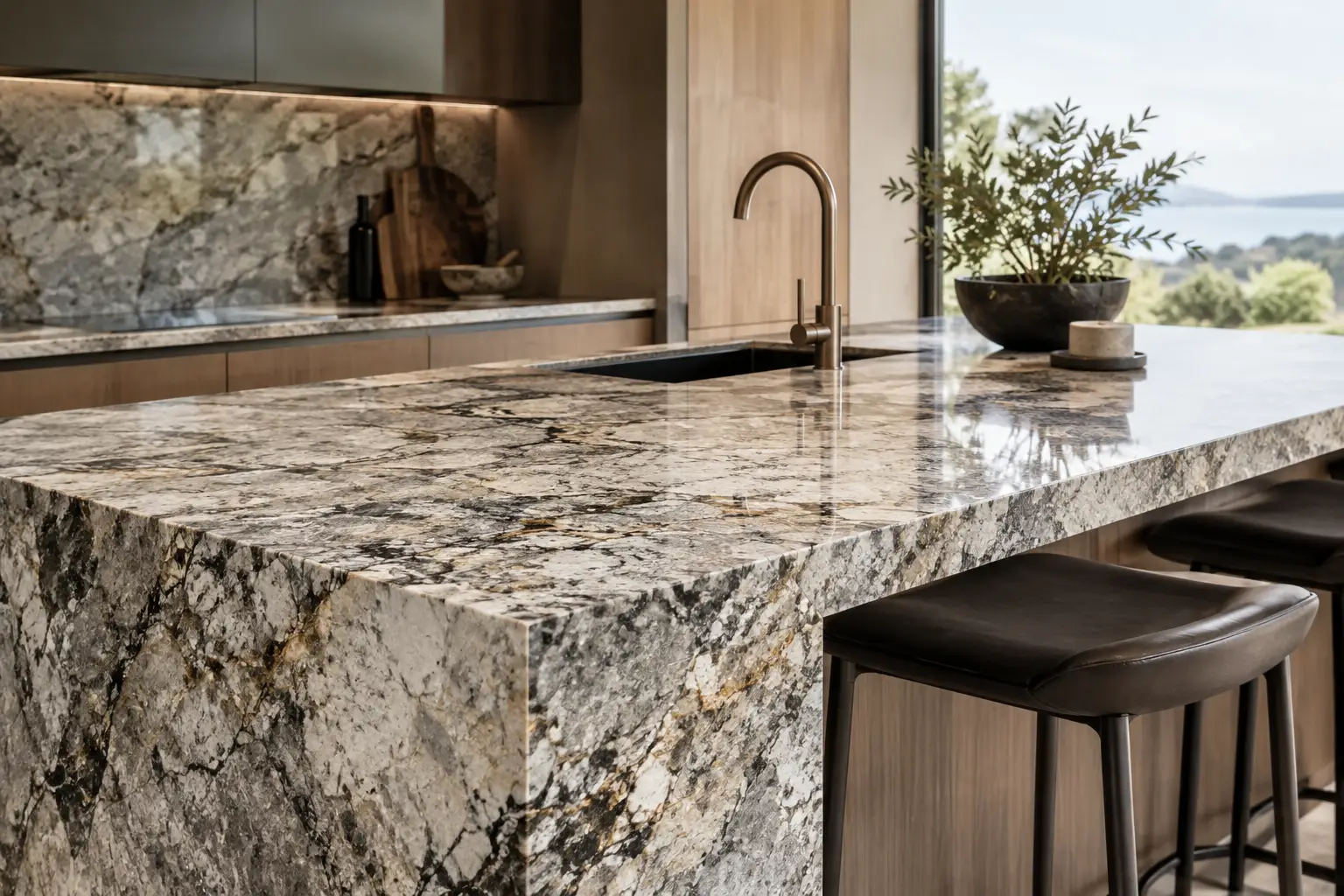
A granite benchtop can bring a sense of permanence to a kitchen that few materials can replicate. Formed over immense geological time, each slab carries its own mineral composition, crystalline detail and natural variation. Some granites appear almost architectural in their restraint, with a deep, consistent ground and fine grain. Others reveal dramatic movement, flashes of mica, sweeping mineral veins or unexpected colour that turns an island into the focal point of the room.
For a design-led project, granite should not be chosen from a small sample alone. It is a material to be seen at slab scale, where its pattern, direction and tonal shifts can be understood in relation to the cabinetry, light and proportions of the space.
Why granite remains an architectural favourite
Granite has long been valued in kitchens, bathrooms and commercial interiors because it balances visual depth with everyday practicality. It is a hard natural stone, and many varieties are well suited to hardworking surfaces when correctly specified, fabricated and maintained. Yet performance is only part of the appeal. Granite has a density and visual complexity that give an interior a more grounded, considered quality.
Unlike a uniform surface, natural granite changes across the slab. A pale stone may contain charcoal speckling, warm mineral notes or silver crystals that emerge as daylight moves through the room. A darker granite can read as quietly sophisticated from a distance, then reveal remarkable detail when viewed closely. This is the value of natural material: it brings a layer of individuality that cannot be repeated exactly.
Granite also works across a wide range of design languages. A finely textured black granite can sharpen a minimal kitchen with timber cabinetry. A warm grey or taupe variety can soften contemporary joinery without becoming decorative. More exotic selections, with expressive movement or crystalline structure, suit projects where the benchtop is intended as a statement rather than a background finish.
Selecting a granite benchtop starts with the slab
A benchtop is experienced as a large, continuous plane. That makes the full slab more relevant than a small colour chip or showroom sample. The sample may indicate the general palette, but it cannot show where a mineral vein travels, how concentrated the pattern becomes, or whether the piece has the quieter areas needed for a long run of cabinetry.
Viewing actual slabs allows the design team to make decisions with intention. Consider where the most distinctive movement should sit. On an island, a strong section of pattern may be positioned to face the living area, creating a considered visual moment. For a splashback or waterfall end, the direction of the stone can be planned so the pattern continues in a way that feels deliberate.
This process also helps set expectations around natural variation. Fissures, crystalline features, shifts in tone and occasional mineral markings are part of the material’s character, not signs that every slab will look identical. Some features may be celebrated; others may be best placed in less prominent areas, depending on the project. A good selection process creates room for both design ambition and practical judgement.
Begin with the room, not just the stone
The most successful granite selections respond to the wider interior. Start with the fixed elements: flooring, cabinetry, wall finishes, tapware and the quality of natural light. A granite that looks cool and graphite-toned under showroom lighting may reveal warmer undertones beside oak joinery or in afternoon sun.
Scale matters as well. In a compact kitchen, heavily patterned granite can become the hero and allow surrounding finishes to remain restrained. In a generous open-plan space, a quieter granite may provide visual weight without competing with furniture, artwork and architectural details. There is no universal rule. The right balance depends on how the room is intended to feel.
It is also useful to decide whether the stone should harmonise or contrast. A dark granite against pale cabinetry creates definition and a clear horizontal line. A warmer stone paired with timber can feel layered and enveloping. If the project includes other natural materials, look for a shared undertone rather than trying to match every surface exactly.
Colour, movement and finish shape the final result
Granite is often associated with dark, granular surfaces, but the category is far broader. Depending on the selection, it can range from near-black and blue-grey through to soft white, olive, brown, gold and richly mineral compositions. Some varieties are relatively uniform; others have broad waves, clusters of crystals or strong directional veining.
A polished finish can heighten colour and reflectivity, bringing out the depth within the stone. It can be particularly effective on darker or more crystalline granites, where the surface catches light and creates a refined, almost liquid appearance. A honed finish offers a softer, more matte expression. It often suits calm, tactile interiors, though it may show marks differently and should be considered in relation to the specific granite variety and how the surface will be used.
Edge detailing deserves the same attention. A slim, clean profile can make a substantial stone feel contemporary and precise. A deeper edge introduces visual presence, especially on an island designed to read as a solid architectural volume. The best choice is usually the one that supports the joinery proportions rather than drawing attention to itself.
Think beyond the horizontal surface
Granite can extend beyond the benchtop to create a more cohesive material story. Using the same stone for a splashback can make a kitchen feel resolved, particularly where the slab’s movement is carefully positioned. A granite-clad island end or waterfall return can turn a functional piece of joinery into a sculptural feature.
In bathrooms, granite can bring depth to vanities, wall linings and thresholds. For hospitality and commercial environments, it can offer a distinctive finish for reception counters, bar fronts or feature surfaces. These applications require project-specific consideration of thickness, detailing, sealing and intended use, but they show how a carefully selected slab can influence an entire space.
Practical considerations for everyday use
Natural stone is not maintenance-free, and that honesty is part of specifying it well. Granite is generally valued for its hardness and resilience, but individual stones vary in porosity and composition. A suitable sealer and appropriate care routine help protect the surface, particularly in areas exposed to food preparation, moisture or frequent use.
For day-to-day cleaning, use a soft cloth with warm water and a pH-neutral stone cleaner where needed. Avoid abrasive pads and harsh household chemicals, which can affect the sealer or surface finish. Wipe spills promptly, especially oils, wine, citrus and strongly coloured ingredients. While granite is commonly chosen for kitchens because it handles daily life well, it remains a natural material and benefits from considered care.
Heat is another area where nuance matters. Granite has a strong reputation for heat resistance, yet sudden or concentrated temperature changes are never ideal for any finished stone surface. Using trivets for very hot cookware is a simple habit that protects both the stone and the overall finish of the kitchen.
For specifiers, confirming slab availability early is equally important. Natural stone is finite and each batch has its own character. If a project requires multiple slabs, splashbacks, cladding or matching elements, the material should be assessed as a complete allocation rather than selected one piece at a time. This gives the design team greater control over continuity, direction and visual balance.
A material selected for your space
A granite benchtop is most compelling when it is treated as more than a durable work surface. It can anchor a kitchen, establish the palette of an interior and introduce a natural counterpoint to precise contemporary joinery. The difference lies in selecting a slab for its specific character, then allowing its colour, movement and scale to inform the design.
At Moonstone, viewing hand-selected natural stone in person gives homeowners and design professionals the opportunity to see that character properly. In an Auckland showroom, the depth of a polished surface, the softness of a honed finish and the individual movement within each slab become clear in a way a small sample cannot convey.
Choose the granite that gives the room something lasting to look at, not simply something to work on.