A marble surface can change the entire reading of a room. It may be the pale, quietly veined bench that brings softness to a sharply detailed kitchen, or the deeply expressive slab that gives a hotel bathroom its sense of arrival. The most successful marble interiors do not use stone as an afterthought. They allow its movement, tone and natural variation to inform the space around it.
Marble has endured because it offers something manufactured materials cannot precisely repeat: geological character. Every slab carries its own veining, mineral detail and shifts in colour. That individuality asks for a more considered design process, but it also creates interiors that feel personal, architectural and lasting.
Start with the slab, not the sample
A small stone sample is useful for narrowing a direction, but it cannot reveal the scale or composition of a full marble slab. A delicate vein on a sample may become a dramatic line across an island. A creamy base that appears consistent at hand size can reveal soft clouds of grey, gold or green when viewed across a wall.
For this reason, marble should be selected as a whole piece of material. Viewing actual slabs allows designers and clients to understand the overall background tone, the density of veining, the placement of distinctive features and how the stone will sit alongside cabinetry, flooring and metalwork. It also creates an opportunity to reserve material with enough continuity for the intended application.
This is particularly important where marble will become the visual anchor of a room. A kitchen island, vanity wall or fireplace surround is not simply a surface to be covered. It is an architectural composition, and the stone deserves to be chosen with that scale in mind.
How marble interiors establish a design language
Marble can lead a scheme in very different directions. A pale white marble with restrained grey veining can bring clarity to contemporary joinery and fine-lined detailing. Warmer marbles with tobacco, honey or rose undertones can make a room feel more layered and inviting. Darker varieties, with bold white movement or rich green-black depth, introduce drama without relying on excessive ornament.
The key is to decide what role the marble will play. In a minimal interior, a highly expressive slab may be the moment of contrast that prevents the room from feeling overly controlled. In a more decorative setting, quieter marble can provide a calm foundation beneath timber grain, textured tiles and aged metal finishes.
There is no universal rule that marble must be paired with white cabinetry or polished brass. Its strength lies in its range. Consider the undertone first: cool grey, creamy ivory, warm beige, green, burgundy or black. Then assess the movement. Fine linear veining can reinforce order and geometry, while broad, organic movement introduces a more sculptural quality.
Let the veining determine the layout
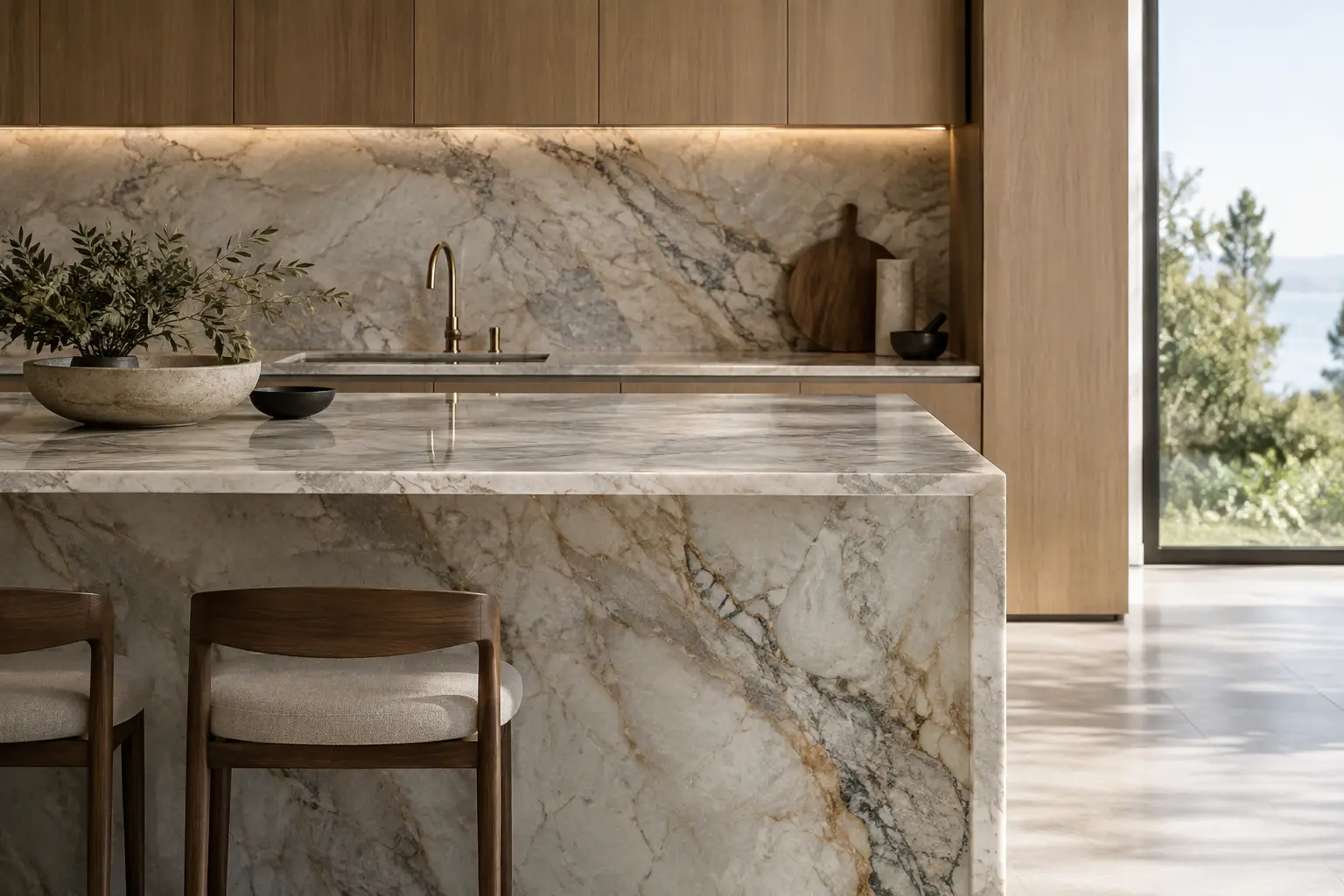
Vein direction deserves early attention. On a long benchtop, linear movement can draw the eye along the length of the room. On a kitchen island, bookmatched or mirrored slabs can create a deliberate central composition. For wall cladding, continuous veining across adjoining panels can make the stone feel monolithic rather than segmented.
Bookmatching is not always the right answer. It suits marble with strong, symmetrical movement and projects that call for visual theatre, such as a reception desk, bar front or feature bathroom wall. A quieter installation may benefit from a more restrained layout, where slabs are selected for tonal harmony rather than mirrored drama.
This conversation should happen before slabs are allocated and cutting plans are prepared. A beautiful material can lose impact if the most distinctive area is placed where it will be interrupted by sinks, hobs, power points or joins.
Choosing the right application
Marble is exceptionally versatile, yet each application has its own visual and practical considerations. In kitchens, it can be used across benchtops, splashbacks and islands to create a complete material story. A full-height splashback often allows the stone’s veining to be appreciated more clearly than a short upstand, particularly when paired with simple cabinetry.
Bathrooms invite a different kind of expression. A marble vanity can bring refinement to a compact powder room, while wall cladding can turn a larger ensuite into a quiet retreat. Where a room has limited natural light, lighter stone with subtle movement can reflect light and retain a sense of openness. In generous, well-lit rooms, darker marble can be used with confidence for a more immersive effect.
Beyond kitchens and bathrooms, marble gives weight and distinction to fireplaces, dining tables, bar tops, reception counters and feature walls. Hospitality and commercial spaces often benefit from this sense of permanence. A carefully chosen natural stone can make an arrival space feel memorable before any furniture or artwork is introduced.
Balance visual impact with daily use
Natural marble rewards an informed approach. As a calcite-based stone, it can react to acidic substances and may develop etching or marks through everyday use. This is not necessarily a reason to avoid it, but it is a reason to select it honestly and use it in a way that suits the project and the people living or working within it.
For clients who value a surface that will develop a lived-in patina, marble can be an enduring choice. The marks of use may become part of its story, especially in a family kitchen or entertaining space. Others may prefer marble in a lower-contact application, such as a vanity, feature wall or fireplace, while choosing another material for a heavily used kitchen zone.
Finish also affects the final experience. A polished surface emphasises depth, contrast and the clarity of veining. Honed marble has a softer, more muted appearance that can suit restrained, tactile interiors. The right choice depends on the stone, the light and the desired level of formality. It should be considered alongside maintenance expectations rather than treated as a purely aesthetic decision.
Pairing marble with other materials
Marble is most compelling when it has room to breathe. It does not need every surrounding material to compete for attention. Timber provides warmth and grain against the stone’s cool mineral depth. Brushed metal brings a refined contrast without distracting from the veining. Plaster, limewash and matt cabinetry can create a quiet backdrop that allows the marble to hold visual focus.
Scale matters here. If the marble is richly patterned, simplify the joinery profile and keep hardware considered. If the stone is understated, there may be more freedom to introduce fluted timber, coloured lacquer or sculptural lighting. The aim is not to match every tone exactly, but to create a relationship between materials that feels intentional.
Lighting deserves equal care. Side lighting can reveal texture and movement across a honed finish, while warm, controlled lighting can bring out honey or brown undertones that may not be immediately obvious in daylight. Always view the selected slab under different conditions where possible. Natural stone changes character throughout the day, which is part of its appeal.
A more considered selection process
A successful marble specification begins with the design intent, then moves into material selection early enough to influence the details. Establish the key application, approximate dimensions, preferred palette and whether the stone needs to work across multiple surfaces. From there, assess available slabs for colour, movement, quantity and visual continuity.
For larger projects, it is worth identifying which faces of the slab should be prioritised for prominent areas. The centre of an island, the wall behind a basin, the front of a reception counter or the main fireplace plane may deserve the most expressive section. Less prominent returns and side panels can be planned around them.
At Moonstone, viewing hand-selected slabs in the Auckland showroom gives designers, homeowners and project teams a direct relationship with the material selected for their space. It replaces assumption with a more confident decision – one based on the actual stone, its natural variation and the role it will play within the finished interior.
Marble asks for attention, but it gives a room uncommon depth in return. Choose a slab that feels right at full scale, let its character guide the detailing, and allow the material to remain visible enough to tell its own story.