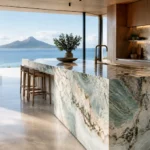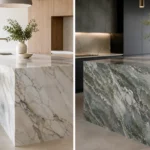
A marble sample can suggest a direction. The full slab makes the decision. Knowing how to select marble slabs means looking beyond a small colour chip and seeing the material as it will live across an island, vanity, fireplace surround or architectural wall. Its veining, tonal shifts and quiet imperfections are not incidental details. They are the character that gives marble its lasting presence.
For a design-led project, marble should be selected early enough to influence the wider palette. Cabinetry, joinery, metalwork, paint and lighting all read differently beside a stone with dramatic movement or a soft, clouded ground. The right slab does more than finish a space. It can establish its visual centre.
How to select marble slabs with confidence
The first decision is not simply white marble versus dark marble. It is about the atmosphere the material needs to create. Some slabs are defined by fine linear veining and a calm, architectural restraint. Others carry broad movement, rich contrast or unexpected mineral colour. Neither approach is inherently more refined. The right choice depends on the scale of the room, the surrounding materials and whether stone is intended to recede or become the focal point.
Begin with the design intention. A restrained kitchen with warm timber and softly coloured joinery may call for marble with gentle variation, allowing texture and craftsmanship elsewhere in the room to remain visible. A large island in a minimal interior can carry much more expressive material, where bold veining gives the room its identity. In hospitality and commercial settings, consider the impression created from a distance as well as up close. Strong movement can read beautifully across a substantial reception desk or feature wall, while a quieter slab may suit repeated surfaces where visual calm matters.
It also helps to consider what will sit alongside the marble. A grey vein can pull cooler when paired with crisp white cabinetry, yet appear warmer beside oak, brass or aged bronze. Green, burgundy, ochre and blue mineral notes can be subtle until they are placed beside a related textile or paint finish. Bring physical samples wherever possible. Digital images are useful for initial direction, but they cannot fully convey depth, polish, translucency or the way colour changes under light.
View the actual slabs, not only a sample
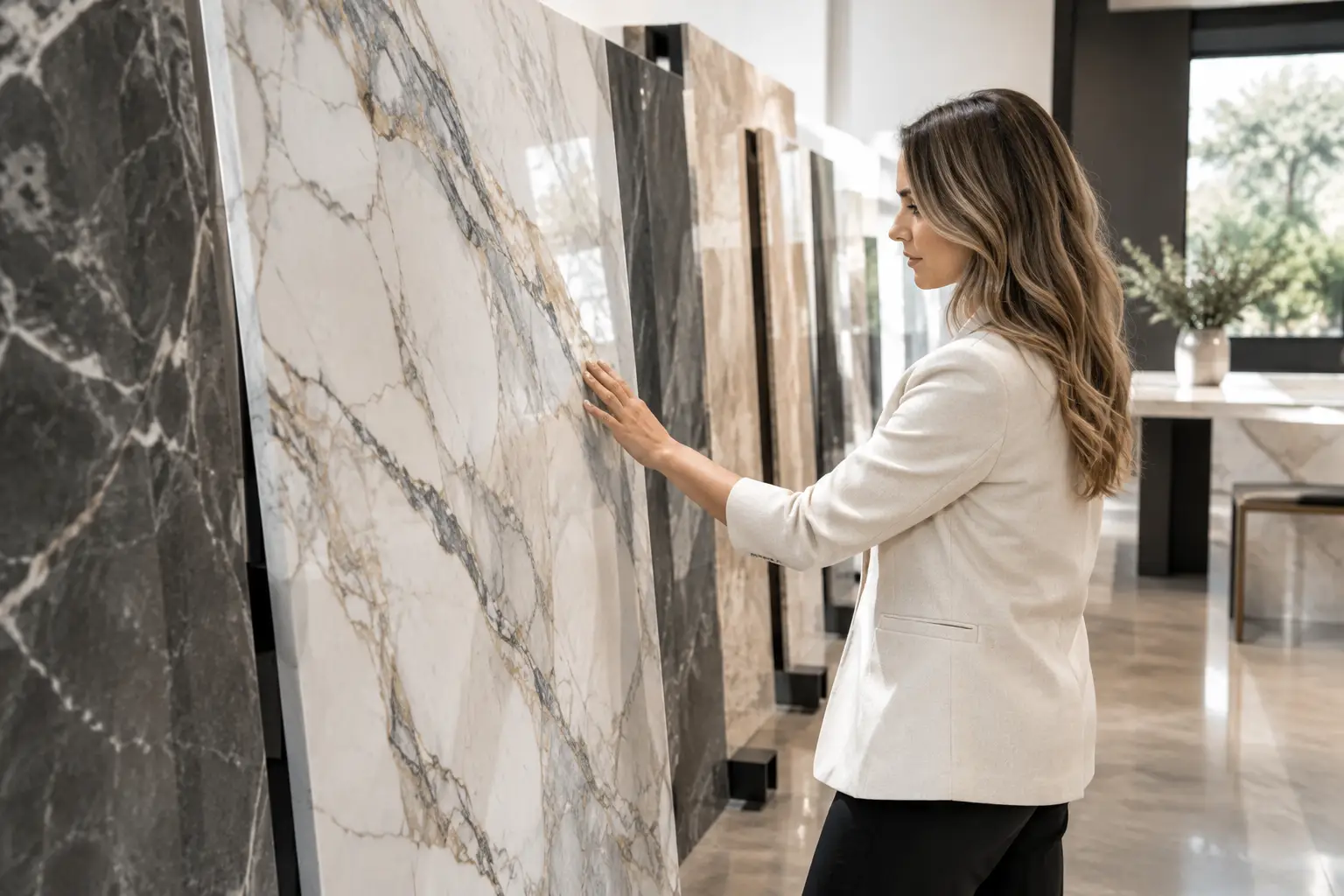
Natural stone is formed over time, not produced to a fixed graphic. That is why viewing the actual slabs allocated to your project is central to a considered selection. A sample may show the base colour and general vein style, but it cannot show the exact composition, movement or natural variation across a full surface.
Stand back first. From a few metres away, look at the overall balance of the slab. Notice where the movement gathers, where the quiet areas sit and whether the composition feels calm, directional, cloud-like or dramatic. Then move closer. Fine fissures, crystalline areas, mineral marks and tonal changes are often part of the authentic character of marble. They should be understood before selection, rather than discovered after the material has become part of the project.
There is no such thing as a completely uniform natural marble slab. If uniformity is the priority, an engineered surface may be more appropriate for that particular application. If the appeal lies in having something individual, then the variations within marble are precisely what make the finished surface personal and distinctive.
Lighting deserves careful attention. Showroom lighting offers a reliable place to assess colour and movement, but the project’s own light will shape the final result. North-facing rooms, warm pendant lighting, shadowy alcoves and bright glazing can all alter how a stone reads. If a slab has pronounced undertones, compare it with the project’s key finishes before making the final decision.
Choose for layout, not just for beauty
A beautiful slab can still be the wrong selection if its movement does not suit the proposed layout. Ask to look at the intended surface dimensions and think about how the stone will be divided. A long, linear vein may be ideal for a sweeping island or wall panel, while a more dispersed pattern can work well across smaller vanities or several connected surfaces.
The most expressive area of a slab is often the natural focus. It may belong at the centre of an island, behind a cooktop, across a fireplace face or at the upper section of a vanity wall. Conversely, a quieter area may be better suited to a return, splashback or secondary piece. This is where early coordination between the designer, client and fabricator is valuable. The aim is to ensure the slab’s best features are positioned with intent rather than lost in offcuts or concealed sections.
Bookmatching can create a striking mirrored composition, particularly for feature walls, fireplace surrounds and large vertical applications. It is not always the answer, however. A bookmatched marble can feel theatrical and architectural in the right setting, while a continuous directional layout may better suit a quieter interior. Ask to see how adjacent slabs relate to one another, especially when the project requires more than one piece.
Allow for the realities of the layout too. Sink and cooktop cut-outs, mitred edges, returns and joints will affect what remains visible. An island with waterfall ends may need additional material to maintain a coherent vein direction. A wall application may require slabs with compatible colour and movement across multiple panels. Selecting sufficient slabs from the same batch helps preserve continuity, though natural variation will always remain part of the finished composition.
Consider scale and thickness
Scale changes the way marble performs visually. A heavily veined stone can appear overwhelming in a compact powder room if it is used across every surface, yet look extraordinary as one carefully framed vanity or wall. In a generous open-plan kitchen, that same stone may need the expanse of a large island to reveal its full movement.
Thickness and edge detail also shape the result. A fine profile can feel light and contemporary; a deeper edge can create a more sculptural, monolithic presence. Neither is simply a technical decision. It affects shadow lines, proportions and the relationship between stone, joinery and surrounding architecture.
Be honest about use and care
Marble is an enduring architectural material, but it is not a material without character in daily use. Its suitability depends on the application, the household or venue, the chosen finish and expectations around patina. Highly polished marble has a luminous, formal quality, while honed surfaces tend to feel softer and more relaxed. Both can show evidence of use differently over time.
In kitchens, acidic foods and liquids can affect the surface of calcareous stone, and marks may be more visible on some colours and finishes than others. In bathrooms, cosmetics, toiletries and standing water should also be considered. This does not rule marble out. It simply means selecting with clear expectations and discussing appropriate care for the intended setting.
For many clients, the gentle evolution of natural stone is part of its appeal. A surface that develops subtle signs of life can feel more authentic than one that remains visually unchanged. Others prefer a material with a more predictable appearance in high-contact areas. The considered choice is the one that aligns aesthetic ambition with the way the space will actually be used.
Look beyond the single hero slab
When selecting marble for a project with several rooms or applications, assess the collection as a whole. The aim is not for every slab to look identical. It is for the variation to feel coherent. One slab may carry more movement, another may be quieter, yet both can belong together through their ground colour, vein tone and overall mood.
This matters particularly where stone continues from benchtop to splashback, from vanity to wall, or from a public area into more private spaces. Establish which surface is the hero and which ones are supporting materials. The hero slab can hold the strongest expression, while adjacent pieces provide continuity without competing for attention.
It is also wise to reserve material with purpose. A rare or dramatic section may be best held for a visible vertical face, a niche, a shelf detail or another architectural moment. A considered stone layout is often what separates a surface that is merely attractive from one that feels integral to the design.
Make the final selection in person
For material with this much nuance, an in-person selection is hard to replace. Walk around the slabs, compare alternatives side by side and give yourself time to notice the details that first impressions can miss. The final choice should feel right from both a practical and emotional point of view: appropriate for the application, aligned with the design, and distinctive enough to remain compelling long after the project is complete.
At Moonstone’s Auckland showroom, viewing hand-selected marble in person allows those decisions to be made around the actual material, not an approximation. Bring plans, elevations, cabinetry samples or a clear sense of the room’s palette. The most memorable marble selections are rarely the loudest. They are the ones selected for the space, with enough confidence to let natural stone be exactly what it is.