A kitchen island is rarely just a work surface. It is where people gather, where light lands, and often where the material palette of the entire room becomes clear. Choosing marble or quartzite for islands is therefore not simply a question of hardness. It is a decision about atmosphere, natural variation and how you want the space to age.
Both materials can create an extraordinary focal point, from quiet, clouded fields to dramatic veining with genuine architectural presence. The right choice depends on the character you want from the stone, the way the island will be used, and your comfort with a natural surface that develops its own story over time.
Marble or quartzite for islands: begin with character
Marble and quartzite may sit alongside one another in a stone showroom, but they create very different impressions in an interior. Marble is prized for its softness of appearance – expressive veining, depth and luminosity that can feel almost atmospheric. It has a timeless association with crafted interiors and remains a compelling choice when the island is intended to feel sculptural rather than purely functional.
Quartzite often presents a more crystalline, layered character. Depending on the slab, it may carry sweeping mineral movement, fine linear veining, vivid tonal shifts or a quieter, more granular depth. Many quartzites offer the visual drama people seek in marble, with a denser and often more resilient surface for an active kitchen.
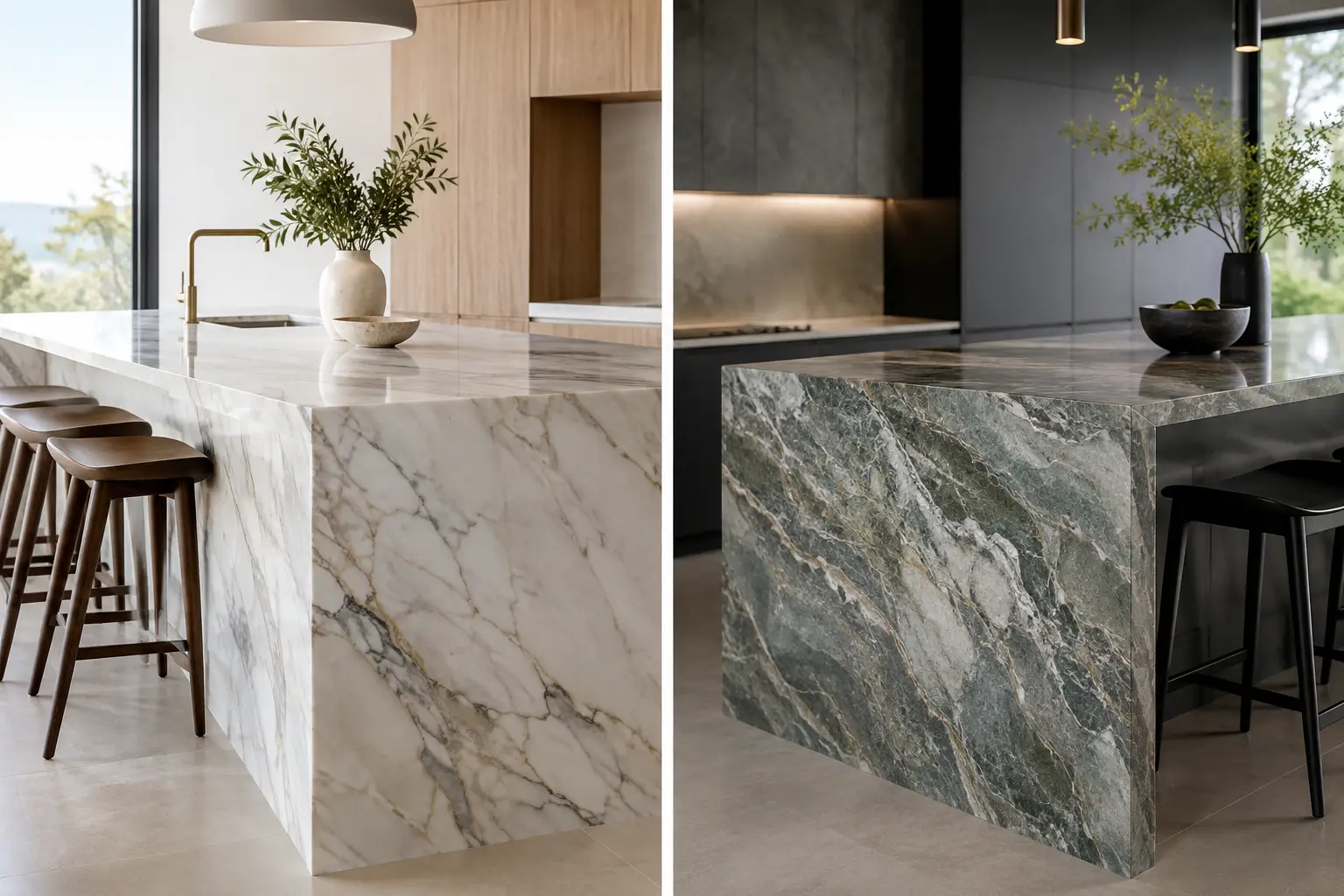
Neither is inherently the more beautiful material. A pale marble with restrained movement may suit a heritage-inspired kitchen, a refined apartment or a space where joinery needs a softer counterpoint. An exotic quartzite can anchor a contemporary room, particularly where the island is designed as a substantial monolith with waterfall ends or a deeply veined statement surface.
The essential distinction is emotional as much as practical. Marble has romance and patina. Quartzite often has intensity, energy and mineral strength.
Marble: a surface designed to be lived with
Marble is a natural stone with a distinctive calcite-rich composition. That is part of what gives it its signature depth and elegant movement, but it also means it can react to acidic ingredients such as lemon juice, vinegar and wine. This reaction is known as etching. It may appear as a dull or lighter mark rather than a stain, and sealing does not prevent it.
For some clients, that is a decisive reason to choose another material. For others, it is precisely the point. A marble island can become more individual through use, collecting subtle marks that soften the surface over time. In a family kitchen where every small change will feel frustrating, marble may demand more care than is welcome. In a considered home where natural patina is appreciated, it can be deeply rewarding.
Marble also requires sensible daily habits. Wipe spills promptly, use chopping boards and avoid leaving acidic food or drinks directly on the surface. A quality sealer can help reduce the likelihood of staining, but it should be understood as protection rather than a guarantee of an unchanged finish.
When selecting marble, the actual slab matters immensely. Vein scale, background tone and areas of natural variation can alter the whole feeling of an island. A bookmatched arrangement may create formal symmetry, while a single uninterrupted slab can feel calmer and more contemporary. These are design decisions best made in front of the material itself.
Where marble excels
Marble is particularly compelling when the island is intended as a centrepiece with enduring elegance. It works beautifully in kitchens with warm timber, brushed metal, painted joinery and natural plaster finishes, because its softness brings complexity without visual noise.
It is also an exceptional choice for clients who understand that natural stone is not a uniform product. Fine fissures, mineral marks and tonal variation are not defects in the architectural sense. They are part of the material’s authenticity and should be selected intentionally.
Quartzite: expressive stone for active kitchens
Quartzite is formed when quartz-rich sandstone undergoes heat and pressure over time. Many true quartzites are valued for their density and resistance to everyday wear, making them a strong consideration for kitchen islands that see frequent cooking, entertaining and family life.
That performance profile should not be mistaken for invincibility. Quartzite still needs appropriate care, and each variety has its own characteristics. Some stones sold under the broad quartzite category may behave differently depending on their mineral composition and finish. This is why slab-specific guidance, including practical suitability for the intended application, is far more useful than choosing by name alone.
Visually, quartzite can be remarkable. Certain slabs feature broad, painterly movement in soft grey, cream, green, blue or gold. Others have a more restrained, architectural grain. Its natural variation can bring a level of depth that engineered surfaces cannot replicate, while giving a kitchen a more assured and substantial presence.
For a large island, quartzite is especially effective when the design calls for continuity across the top and sides. A dramatic vein can travel over a waterfall end, turning the island into a single composed object rather than a bench with an added edge. Where the slab has exceptional movement, this approach allows the stone to lead the design.
Where quartzite excels
Quartzite suits projects where the island needs to make a visual statement while accommodating a busy routine. It is often favoured for open-plan kitchens, hospitality-inspired entertaining spaces and homes where the bench is used throughout the day.
Its varied palette also gives designers room to work. A quiet quartzite may support strong joinery and lighting, while a rare, exotic selection can become the dominant material from which the rest of the room takes direction.
Consider the island as a complete composition
The decision should extend beyond the top surface. Island proportions, edge profile, overhangs, cabinetry colour and the relationship to splashbacks all influence whether marble or quartzite feels right.
A heavily veined marble can be extraordinary on a generous island, but may feel crowded if used again on every wall. In that setting, a restrained splashback or complementary paint colour can give the island room to breathe. Conversely, a quartzite with fine, directional movement may be repeated across a splashback to create a continuous, immersive material expression.
Lighting matters too. Marble often responds beautifully to soft natural light, which reveals its translucency and layered veining. Quartzite can hold its presence under stronger lighting and may reveal crystalline detail that is less visible in photographs. Neither should be selected from a small sample alone when the project calls for a statement island.
Viewing full slabs allows you to assess the parts that matter: overall movement, colour shifts from one end to the other, the scale of veins, and where a fabricator may position the most distinctive areas. It also provides a realistic sense of how the stone will sit with cabinetry samples, timber finishes and metal details.
Ask the questions that lead to the right material
Rather than asking which stone is better, ask what the island needs to do. Will it be a daily preparation zone for a young family, an elegant gathering point for entertaining, or an architectural feature in a quieter apartment kitchen? Are you drawn to the perfection of a pristine surface, or do you value the patina that comes from genuine use?
It is equally useful to consider your design horizon. Marble can feel increasingly beautiful as it gains character, while quartzite may offer more reassurance for clients who want a natural surface with greater confidence around day-to-day use. Both reward thoughtful selection and regular care.
A showroom appointment is valuable at this point, not because the choice needs to be complicated, but because it becomes clearer when the slabs are in front of you. At Moonstone’s Auckland showroom, clients and design professionals can view hand-selected natural stone in full scale and select material in relation to their specific project.
The most successful island is not the one that follows a rule about marble or quartzite. It is the one whose colour, movement and natural character make the room feel unmistakably its own – and still feel right once the kitchen is being properly lived in.