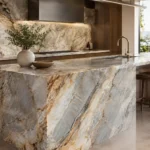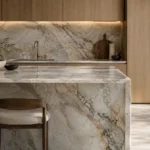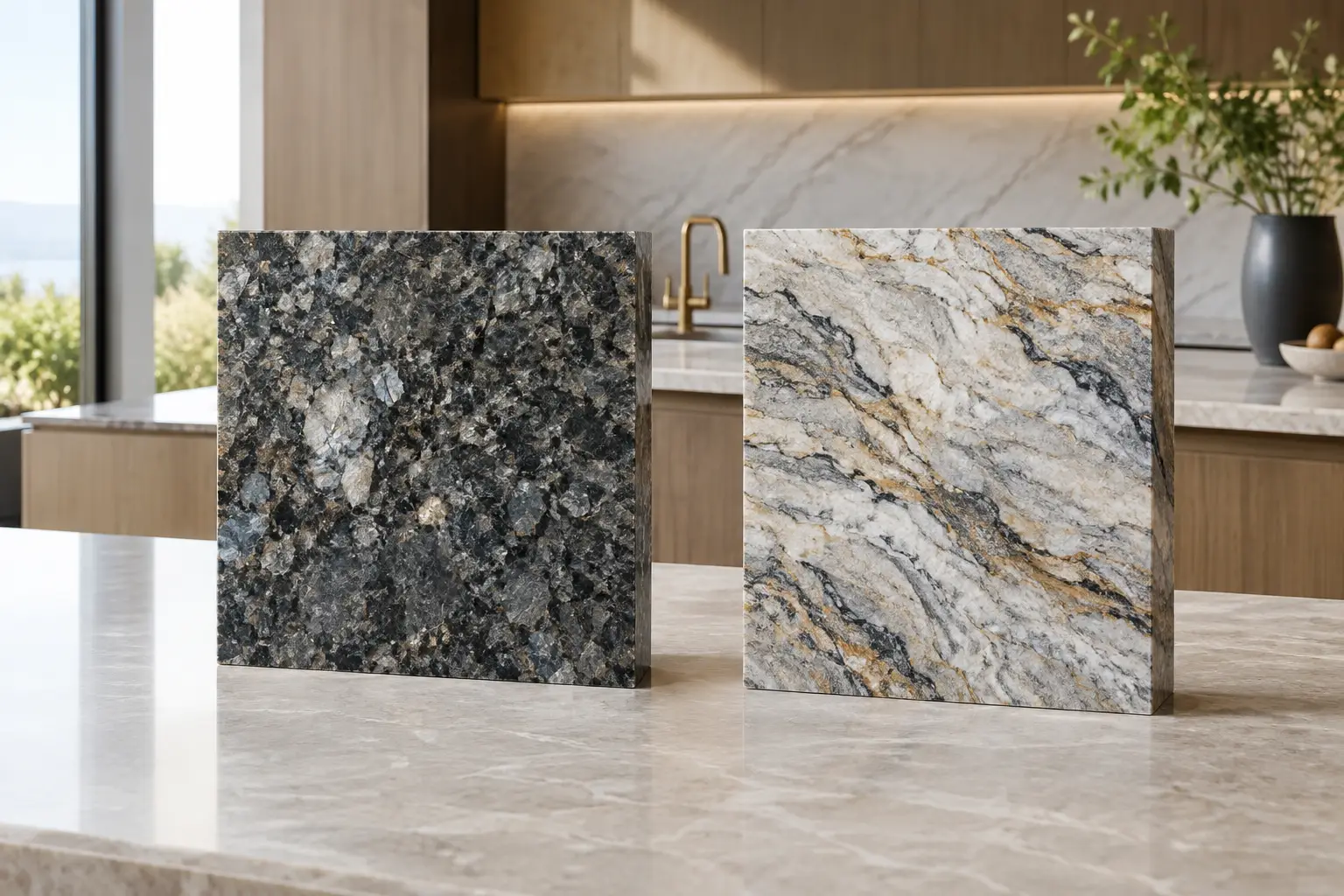
A pale, crystalline quartzite island and a deeply textured granite benchtop can both feel remarkably solid beneath the hand. Yet granite versus quartzite durability is not a simple contest with one universal winner. Both are enduring natural stones suited to demanding architectural spaces, but their performance depends on mineral composition, slab structure, finish, fabrication detail and how the surface will be used.
For a kitchen designed around a statement island, or a hospitality project with a high-touch bar surface, the most useful question is not simply which stone is harder. It is which hand-selected slab has the right balance of visual character, practical resilience and care requirements for the space.
Granite versus quartzite durability: the essential difference
Granite is an igneous stone, formed as molten material cools slowly beneath the earth’s surface. It is typically made up of interlocking crystals of quartz, feldspar and other minerals. This dense crystalline structure gives granite its familiar strength, varied grain and exceptional depth of colour.
Quartzite begins as sandstone and is transformed under intense heat and pressure. In a true quartzite, the original quartz grains recrystallise into a tightly bonded material. The result can be extraordinarily hard, with luminous movement that ranges from quiet whites and greys to dramatic veining and exotic colour.
On the Mohs scale, granite commonly sits around 6 to 7, while true quartzite is often around 7. In everyday terms, quartzite may have a slight advantage against scratching, particularly in busy kitchens. But hardness is only one part of durability. A stone can be highly scratch-resistant while still needing considered care around staining, edge impacts or particular mineral inclusions.
Natural stone is never entirely uniform. Two slabs described under the same material family can behave differently, which is why viewing actual slabs and understanding their individual character matters.
Scratch resistance in a working kitchen
Both granite and quartzite perform well in kitchens where plates, cookware and serving pieces are used daily. Granite has long been valued for its ability to tolerate the rhythm of family life, from food preparation to entertaining. Its crystalline surface resists ordinary wear well, especially when selected with an appropriate finish and maintained as recommended.
True quartzite is generally among the hardest natural stone choices for benchtops. It is well suited to clients who want the refined, organic movement of natural stone without choosing a material that feels overly delicate. A leathered or honed quartzite can bring softness and texture to a kitchen while retaining excellent everyday scratch resistance.
Neither surface should be treated as a chopping board. Knives may not readily damage the stone, but they can blunt against it, and repeated force in one area is unnecessary. The greater risk is often to the object being placed on the benchtop rather than the stone itself.
Heat, impact and the realities of daily use
Granite and quartzite are formed in conditions far more extreme than a domestic kitchen. Both generally manage incidental heat well, making them practical choices near cooktops and for serving areas. Even so, hot cookware should be placed on a trivet rather than directly onto any benchtop. This protects the surface from sudden temperature changes and helps preserve sealers, joins and the surrounding cabinetry.
Impact resistance requires a more measured view. A broad, supported area of either stone is exceptionally strong. Edges, cut-outs and narrow sections around sinks or cooktops are naturally more vulnerable, particularly if struck by a heavy cast-iron pan or a dropped object. Durability here is shaped as much by thoughtful design and skilled handling as it is by the material itself.
A substantial edge profile can give a kitchen island architectural presence, but it should be selected with the intended use in mind. Fine profiles create a crisp contemporary line, while softer eased or rounded edges can be more forgiving in high-traffic family spaces.
Staining and sealing: where the comparison becomes more individual
Porosity varies across both granite and quartzite. Some granite is very dense and requires little maintenance beyond periodic sealing, while other varieties have more absorbent mineral areas. Quartzite can also range from remarkably dense to more open in certain zones, particularly where natural fissures, movement or softer mineral deposits occur.
Sealing does not make stone maintenance-free. It helps slow the absorption of oils, wine, citrus and other household spills, giving time to wipe them away. A well-sealed surface should still be cleaned promptly with a pH-neutral stone cleaner or a soft cloth and mild soap. Harsh chemicals, bleach-based products and abrasive powders are better kept away from natural stone.
For both materials, a simple water test can help indicate whether resealing may be needed. If water darkens the surface quickly rather than beading for a period, it may be time to discuss appropriate care with the relevant stone professional. The frequency will depend on the specific slab, the finish and the intensity of use.
Acid resistance and the importance of identifying the slab
Granite and true quartzite are generally more resistant to acidic foods than marble. That makes them compelling materials for kitchen benchtops, vanities and entertaining spaces. However, the category name alone should never be treated as a full performance specification.
Some stones sold in the wider market as quartzite may contain minerals that respond differently to acid, or may be closer in composition to marble or dolomitic stone. Certain dramatic quartzites also contain natural veins, pockets or areas of variation that contribute to their distinctive character but deserve specific discussion before selection.
This is not a reason to avoid expressive material. It is a reason to select with clarity. Ask about the individual slab, its finish, its likely care needs and whether a sample test is appropriate for the intended application. A surface chosen with this level of attention becomes a considered part of the design, rather than an assumption made from a label.
Choosing between granite and quartzite for different spaces
Granite is often the natural choice for clients drawn to granular pattern, dark mineral depth, rich earth tones or a more visibly crystalline surface. It is an enduring option for hardworking kitchens, outdoor-adjacent areas and commercial applications where strength and visual texture need to sit together comfortably.
Quartzite suits projects seeking elegant movement, pale tonal layering or the visual drama often associated with more delicate stones, paired with strong day-to-day performance. It can transform a large island into the defining architectural material of a room, particularly when the veining is carefully considered across adjoining slabs.
For bathrooms, both can be beautiful and practical, although the visual direction may lead the decision. A richly patterned granite vanity can bring depth to a restrained interior, while a softly veined quartzite may create a quieter, more expansive feel. In wet areas, finishes, splash exposure and regular cleaning habits should all be considered alongside the stone itself.
Durability begins with material selection
The most successful natural stone projects do not separate beauty from performance. They recognise that a dramatic vein, a crystalline field, a natural fissure or a shift in colour is part of what makes each slab singular. These features should be assessed for their design contribution and their practical implications before the material is specified.
Viewing full slabs is especially valuable with quartzite and granite. Small samples cannot reveal the scale of movement, the location of natural variation or the way light changes across a finish. At Moonstone’s Auckland showroom, designers and private clients can consider actual slabs in relation to cabinetry, timber, metalwork and the wider palette of a project.
For a family kitchen with constant use, a dense granite or true quartzite in a practical finish may be ideal. For a refined hospitality interior, the decision may rest on how the stone reads under ambient lighting and how the design resolves vulnerable edge details. In each case, the material should be selected for the space it will inhabit, not only for a generic durability ranking.
Granite and quartzite both offer the kind of lasting quality that allows natural stone to age with a project rather than date it. Choose the slab whose character belongs in the room, then give its particular composition and finish the care they deserve.