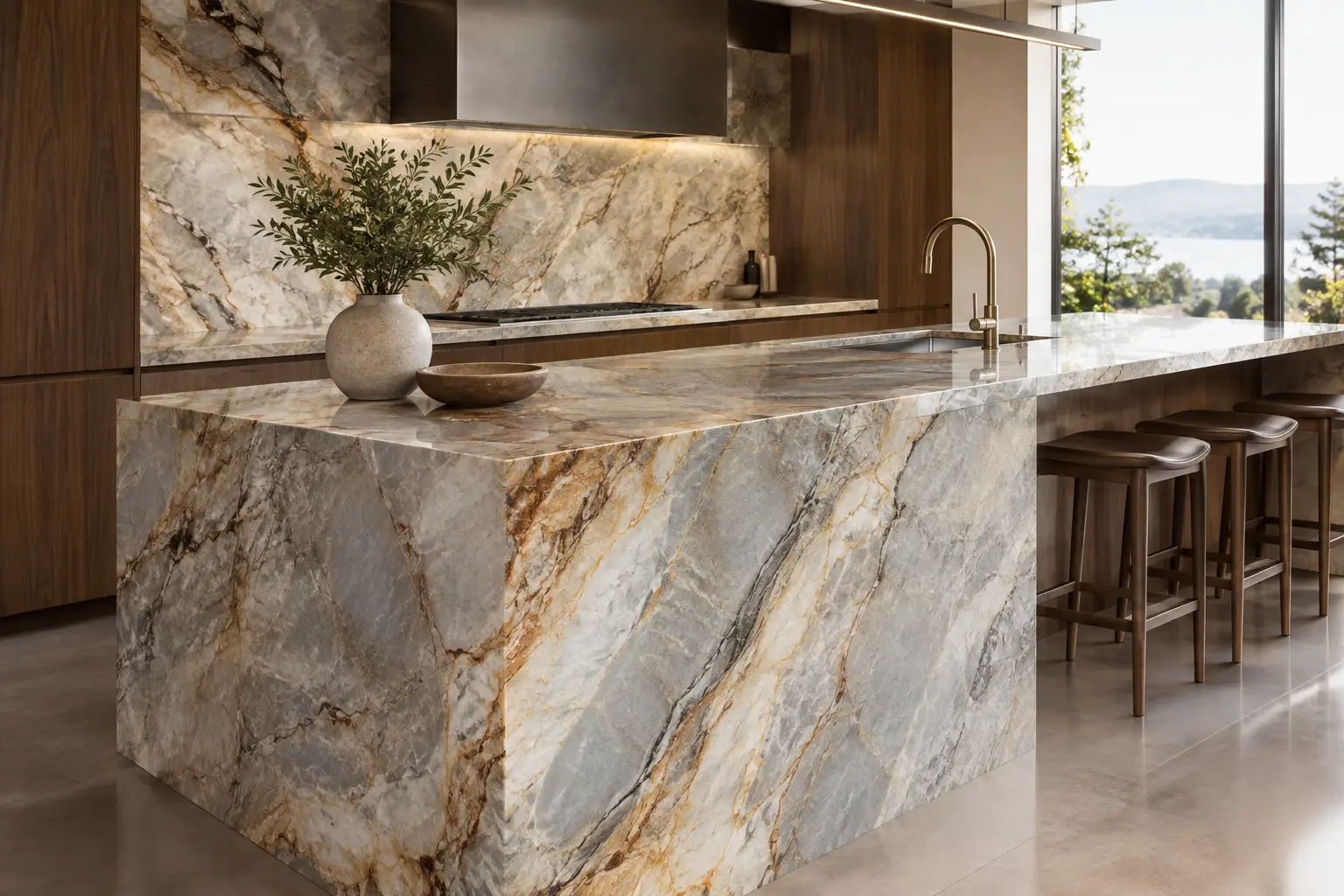
A quartzite island is rarely just a benchtop. It can set the visual direction for an entire kitchen – drawing cabinetry, metalwork, lighting and joinery into a more considered composition. Quartzite slabs are chosen for this presence: their layered movement, crystalline depth and natural variation bring an individuality that cannot be replicated from a sample alone.
For architects, designers and homeowners creating spaces with real material character, quartzite offers a compelling balance. It feels geological and enduring, yet its range is remarkably broad. Some slabs are quiet and pale, with soft mineral clouds and fine linear detail. Others are dramatic, with sweeping veins, rich earth tones or translucent crystalline areas that invite a more expressive application.
What makes quartzite slabs distinctive?
Quartzite is a natural stone formed when sandstone is transformed by heat and pressure over time. That origin is visible in the material. Rather than presenting as a flat, uniform surface, it often carries movement through the slab – bands of mineral colour, delicate fissures, crystalline texture and veining that may run in a clear direction or unfold more organically.
This is precisely why quartzite deserves to be selected in person. A small sample can indicate colour, but it cannot communicate the scale of the movement, the depth of the background or the way light travels across the surface. Two slabs from the same block can share a family resemblance while still having their own distinct composition.
Natural variation is not an inconsistency to work around. In the right project, it is the material’s value. A carefully selected slab gives a kitchen island a sense of permanence, gives a vanity a more sculptural quality, or allows a feature wall to read as a single architectural gesture.
Quartzite is not engineered quartz
The similar names can cause confusion. Quartzite is a natural stone, quarried in slabs and shaped by geological processes. Engineered quartz is a manufactured surface with its own visual and practical characteristics.
Neither material is simply a substitute for the other. The choice comes down to the design intention, the desired level of natural variation and the way the surface will be used. Where the brief calls for a singular, expressive piece of natural material, quartzite is often worth considering early in the specification process.
Choosing quartzite for the way a room will feel
The most successful stone selections begin with the overall atmosphere of a space, not a single close-up image. Consider whether the interior needs calm continuity or a focal point. A softly patterned quartzite may support an understated palette of timber, plaster and brushed metal. A slab with bold directional veining can become the central event in a kitchen, lobby or hospitality bar.
Scale matters as much as colour. A large island provides room for the full narrative of a slab to appear, while a compact vanity may call for a quieter section or a stone with finer movement. On a wall, broad veining can feel almost landscape-like. Used sparingly, the same stone can bring character without dominating the room.
It also helps to view adjacent finishes alongside the actual slab. Cabinet samples, floor finishes, paint colours and metal details all change the way a stone is read. Warm timber can heighten honey or gold tones within quartzite. Cooler joinery may draw out silver, grey or blue mineral notes that were less apparent at first glance.
Direction, joins and bookmatching
Before a stone is finalised, the design team should consider how its movement will travel through the finished application. Directional veining can be installed to run lengthways across an island, vertically up a splashback or continuously around a return. Each approach creates a different visual rhythm.
For projects using more than one slab, slab allocation is part of the design process. The placement of joins, the relationship between adjacent pieces and the selection of areas for cut-outs can all influence the final result. Bookmatching – where two adjoining pieces mirror one another – can create a striking symmetrical effect, particularly on feature walls and full-height bathroom surfaces. It is not right for every stone or every room, but when the slab has suitable movement, it can be exceptionally effective.
These decisions are easier when they happen before cutting begins. Viewing whole slabs allows designers and clients to understand where the most distinctive areas sit and how the material may be composed for the space.
Where quartzite works beautifully
Quartzite has a natural affinity with kitchens, particularly generous islands where its scale can be appreciated. It can bring warmth and complexity to contemporary joinery, or introduce a more refined counterpoint to a classic kitchen. Splashbacks and integrated wall cladding can extend the material beyond the horizontal plane for a more resolved result.
In bathrooms, quartzite can create a quiet sense of luxury without relying on excessive ornament. A vanity top, shower wall or framed stone detail can provide texture and visual depth against simple fittings. The finish selected, lighting conditions and the amount of stone used will shape whether the room feels serene, dramatic or somewhere in between.
Beyond the home, quartzite is well suited to design-led hospitality and commercial interiors where material selection carries the identity of the space. Reception counters, bar fronts, fireplace surrounds, retail displays and feature walls all offer opportunities to use stone as an architectural material rather than a surface chosen at the end of a project.
That said, not every application needs a heavily veined statement slab. A restrained quartzite with tonal movement may be the more sophisticated choice where the architecture already has strong form, detailed timberwork or a layered art collection.
Performance should be considered project by project
A natural stone selection should always be matched to the requirements of the specific application. Quartzite is widely valued for its strength and suitability for a range of interior surfaces, but each variety has its own composition, finish and visual characteristics. Usage, exposure to moisture, the preferred edge detail and the maintenance expectations of the client should all be discussed with the relevant project team.
Fabrication and installation details also matter. The thickness of the material, support requirements, cut-outs and the handling of prominent veins or natural features should be assessed by an experienced fabricator before final approval. This is not about diminishing the beauty of the stone; it is how that beauty is carried through with care and craftsmanship.
Maintenance should be approached honestly. Natural stone benefits from considered day-to-day care, including prompt attention to spills and cleaning products appropriate for stone surfaces. Depending on the particular quartzite and its intended use, sealing may be recommended by the fabricator. Clear guidance at handover helps ensure the material continues to look considered rather than merely new.
Why actual slab selection matters
Selecting from photographs can be useful for initial inspiration, but it is not a substitute for standing in front of the stone. Light reveals details a screen can flatten: small shifts in colour, subtle crystalline areas, the depth behind a vein and the balance between calm and movement across the full slab.
It is also a practical project decision. Actual slab selection allows the team to confirm that the stone aligns with the intended palette, the required quantity and the planned layout. For a major island or full-height feature, seeing the full scale is particularly valuable.
At Moonstone, the showroom-led process gives clients and design professionals the opportunity to view hand-selected natural stone and choose material for the particular demands of their space. For Auckland projects and projects supplied throughout New Zealand, this personal stage can turn an attractive material choice into a truly resolved design decision.
The right quartzite does not need to compete for attention. It simply gives a room something lasting to return to: natural movement, considered scale and a surface that feels selected for that space alone.