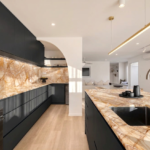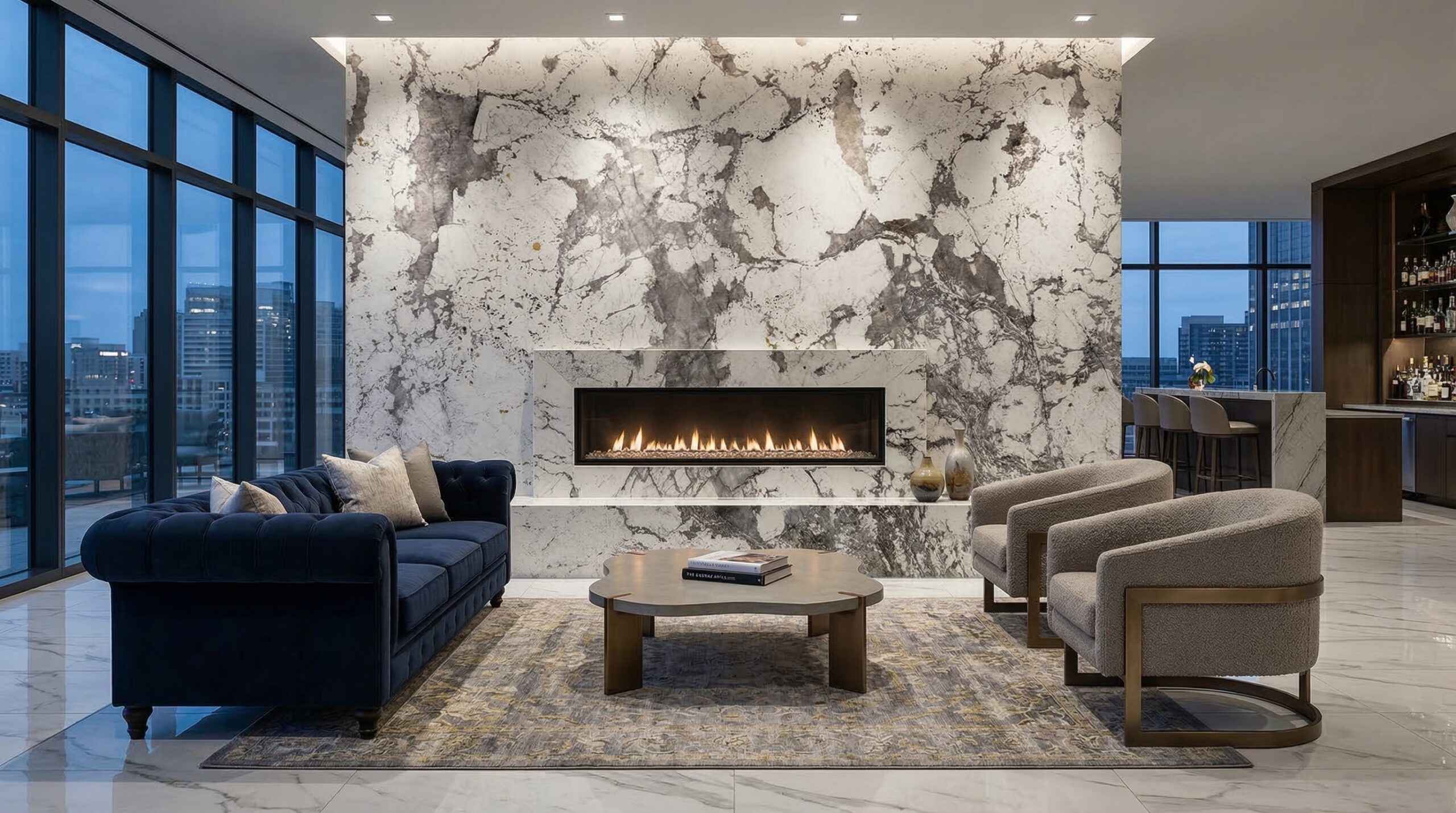
A feature wall should do more than fill a blank surface. Natural stone feature walls introduce depth, scale and a sense of permanence that paint, wallpaper and repeated finishes rarely achieve. A single carefully selected slab can become the visual anchor of a kitchen, living space, bathroom or hospitality interior, carrying the eye through a room with natural movement that cannot be replicated.
For design-led projects, stone is not simply a finish applied at the end. It is an architectural material that helps establish the mood of the entire space. The right selection can feel quiet and monolithic, richly expressive, softly textural or dramatically sculptural. The difference lies in choosing the stone for the wall, the light and the wider material palette, rather than choosing from a small sample in isolation.
Why natural stone feature walls create lasting impact
Natural stone has an inherent visual complexity. Veining shifts across a slab, mineral deposits create subtle tonal changes, and each block holds markings formed over millennia. On a vertical plane, these qualities become especially visible. A wall gives the material room to speak at a scale that a smaller splashback or vanity may not.
This is why slab selection matters. A dramatic quartzite with sweeping movement may suit a double-height entry or a generous fireplace wall, where its scale can be appreciated from across the room. A softly veined marble might bring calm to a refined bathroom or bedroom, while a deeply coloured granite can give a bar, reception area or dining space greater weight and presence.
There is also a tactile quality to stone that changes how an interior feels. Even a honed surface has visual depth. A leathered or textured finish can introduce shadow and relief, particularly where directional lighting catches the surface. The result is not decoration for decoration’s sake. It is material character that gives architecture a focal point.
Start with the wall, not just the stone
The most successful natural stone feature walls begin with a clear understanding of the wall’s role. Is it the first surface seen on arrival? Does it frame a fireplace, sit behind a bed, form the backdrop to a reception desk or continue a kitchen island material vertically? Each setting calls for a different balance of movement, colour and visual intensity.
A prominent wall can carry a bolder slab, but it still needs to belong to the room. Consider the scale of joinery, floor tone, ceiling height and the amount of daylight. A heavily veined stone placed opposite a highly figured timber may create energy and contrast, or it may make the space feel unsettled. It depends on whether the design calls for layered expression or a more restrained composition.
Lighting is equally influential. Strong side light reveals texture and natural variation, while even ambient light can make a pale stone feel expansive and serene. In rooms with limited daylight, consider how the stone will read in the evening, not only in a showroom or during midday site visits. Warm lighting can draw out gold, russet and cream tones; cooler light may accentuate grey, blue or white mineral detail.
A feature wall also benefits from surrounding restraint. When the stone has exceptional movement, simpler adjacent materials often allow it to remain the centre of attention. This does not mean the rest of the scheme needs to be plain. It means each material should have a deliberate role.
Think in full slabs and bookmatched pairs
Small samples are useful for narrowing a direction, but they cannot communicate the scale, flow or variation of a full slab. A vein that appears subtle in a sample may become a powerful diagonal line across a three-metre wall. Conversely, a stone selected for its striking centre may have quieter areas that are ideal for returns, reveals or adjoining surfaces.
Viewing actual slabs allows designers and clients to assess the composition as a whole. It also creates an opportunity to consider the orientation of the material. Veins can run horizontally to widen a room, vertically to heighten it, or continuously through adjoining planes for a more immersive effect.
Bookmatching is particularly effective where a wall is intended to feel sculptural. Two slabs are opened like the pages of a book, creating mirrored movement at the join. The effect can be remarkably dramatic in marble, onyx and certain quartzites, though it is not automatically the right choice for every project. In a quieter interior, continuous veining or a single expansive slab may feel more natural and less formal.
Selecting the right stone for the setting
There is no universal best stone for a feature wall. The material should respond to the design brief, expected use and the atmosphere required.
Marble is often chosen for elegant veining, luminous backgrounds and timeless refinement. Its natural variation can range from delicate and understated to expressive and high-contrast. In considered interior settings, marble creates a sense of softness and sophistication that works beautifully behind fireplaces, in bathrooms, at entries and within boutique hospitality spaces.
Quartzite offers distinctive movement and a broad range of tones, often with crystalline detail that gives a wall remarkable depth. It can suit projects seeking the visual drama of rare natural stone while maintaining a composed, architectural feel. Each variety should be assessed individually, particularly where the wall is exposed to moisture, heat or heavier day-to-day contact.
Granite can bring rich mineral character, deep colour and a more grounded presence. It is especially compelling in commercial, hospitality and contemporary residential spaces where the brief calls for a stronger, more tactile material statement.
Onyx is selected for a different kind of impact. Its translucency can create an extraordinary effect when designed with appropriate backlighting, revealing layers, clouds and mineral formations within the stone. This makes it well suited to bars, feature panels, reception areas and other spaces designed for atmosphere. It also requires careful planning, as lighting, slab layout and the supporting details are central to the finished result.
Details that preserve the design intent
A stone wall is only as convincing as its layout. The placement of joins, the thickness of returns, the alignment with cabinetry and the treatment of openings all influence whether the finished surface feels intentional.
Where possible, plan slab divisions early. A join should sit where it supports the composition rather than interrupting the most compelling movement. This may mean centring a vein, balancing two adjacent slabs or locating a join around a fireplace opening, joinery line or shadow gap. Early coordination between the design team, fabricator and builder is valuable because the stone layout can influence supporting details before construction progresses too far.
Edge treatments deserve the same consideration. Fine shadow gaps can make a stone plane feel clean and architectural, while mitred returns may create the impression of greater mass. In other settings, a visible stone edge can celebrate the material honestly. There is no single correct detail, but it should align with the overall language of the interior.
For wet areas and exterior-adjacent applications, material suitability and detailing should be considered from the outset. Natural stone varies in composition and behaviour, so the appropriate product, finish and project-specific treatment should be discussed with the relevant professionals. A beautiful selection deserves a setting that respects its characteristics.
A personal selection process makes the difference
Feature walls are often the surfaces people remember. They are seen from a distance, touched up close and photographed repeatedly. That makes them a poor place for a generic decision.
At Moonstone, viewing hand-selected slabs in person gives clients and specifiers the chance to respond to the material itself: the direction of its movement, its depth of colour and the natural variation that makes it singular. For Auckland projects and New Zealand-wide supply, this showroom-led approach helps turn an initial concept into a selection made for the actual space.
The final choice may be a quiet marble that rewards close attention, an exotic quartzite with confident movement, or an onyx panel that transforms after dark. The most enduring result is not necessarily the boldest stone in the room. It is the slab whose character feels inseparable from the architecture around it.