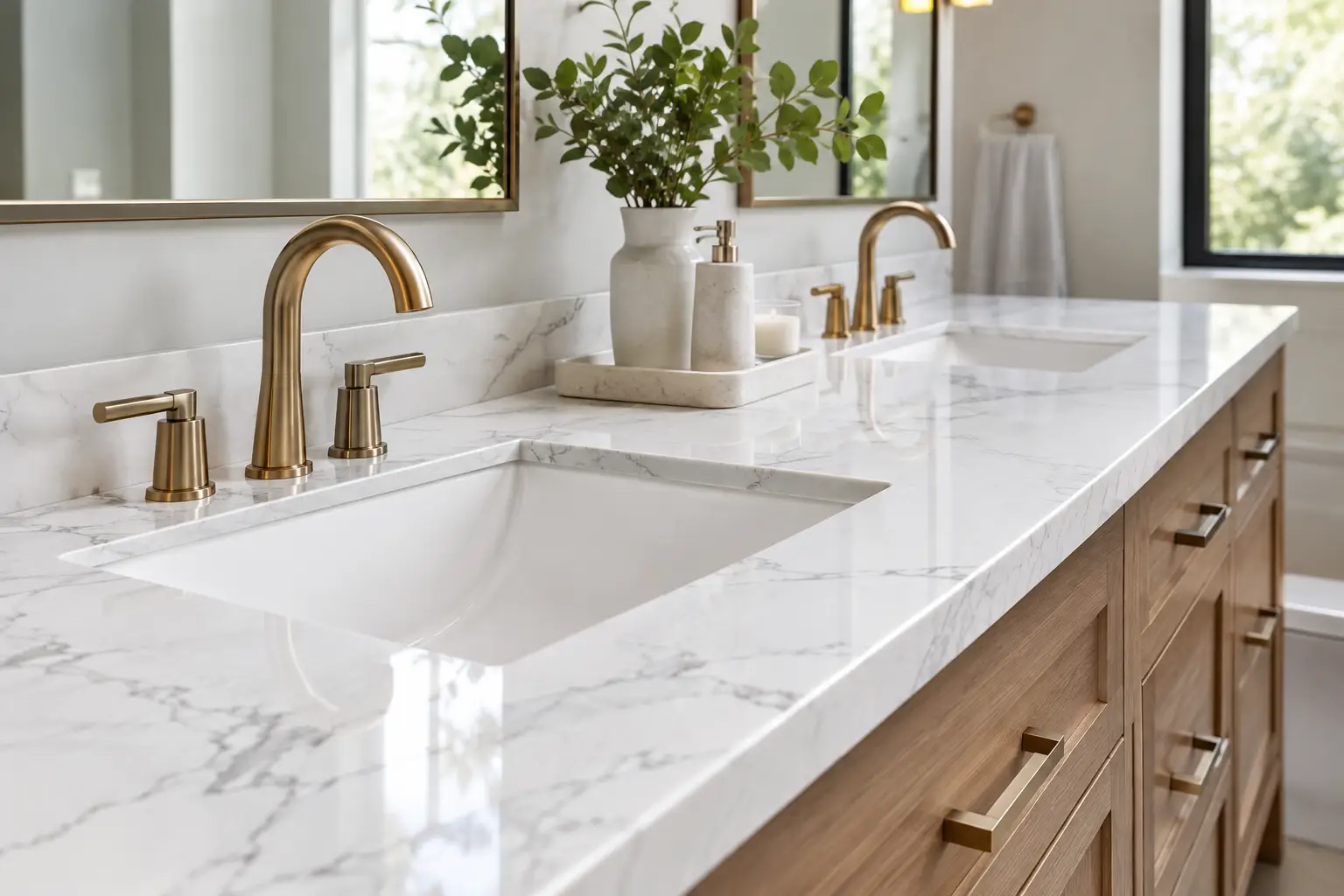
A bathroom vanity is often the first surface touched each morning and the last one used at night. Quartz bathroom vanity tops give that daily ritual a more considered setting: a refined plane of colour, subtle movement and reliable performance around water, cosmetics and changing temperatures.
For a high-value renovation or new build, the right vanity top does more than complete the cabinetry. It can set the visual direction for the entire room, whether the brief calls for quiet tonal restraint, a crisp contemporary contrast or the drama of veining that draws the eye through the space.
Why quartz works so well in bathrooms
Quartz surfaces are engineered from natural quartz minerals combined with resins and pigments. The result is a dense, non-porous material with excellent consistency and a broad range of colour and pattern options. Unlike many natural stones, quartz does not usually require sealing, which makes it especially appealing where a bathroom needs to look immaculate without demanding a complex maintenance routine.
Its non-porous surface resists everyday moisture and is less likely to absorb makeup, toothpaste, soap residue or the occasional spill from a fragrance bottle. That practicality matters in family bathrooms, guest ensuites and high-use powder rooms alike. A soft cloth, warm water and a pH-neutral cleaner will handle most daily care.
The design advantage is equally persuasive. Quartz can deliver a clean, even white, a deep charcoal, warm sand tones or expressive marble-inspired veining without making the room feel visually busy. For projects where joinery, tapware and tile have already been specified, this control can make the final material selection far easier.
There are limits to understand. Quartz is highly durable, but it is not indestructible. Extremely hot styling tools should not be placed directly on the surface, and harsh chemicals, abrasive cleaners and strong dyes can affect its finish over time. A well-designed bathroom allows for a heat-safe tray near power points and uses appropriate cleaning products from day one.
Choosing quartz bathroom vanity tops with intent
The best selection begins with the room rather than a small sample. A compact ensuite and a generous master bathroom may suit entirely different surfaces, even when the cabinetry is the same colour. View full slabs wherever possible. Pattern scale, mineral detail and undertones are difficult to judge from a small swatch, particularly under showroom lighting.
Start with the room’s natural light
North-facing rooms can carry deeper tones, soft charcoal and assertive veining with confidence. Bathrooms with limited natural light often benefit from pale quartz with gentle movement, which lifts the space without becoming clinical. Warm whites tend to sit more comfortably with timber cabinetry, brushed brass and bronze tapware, while cooler whites can sharpen a scheme built around chrome, nickel or grey porcelain.
Artificial lighting changes the reading of a surface too. Test selections beneath the intended mirror lighting and ceiling lights where practical. A quartz top that appears crisp in daylight can look noticeably creamier under warm LED lighting. That is not a flaw, but it should be an intentional part of the palette.
Consider movement, not just colour
Plain quartz has a place in architectural bathrooms where clean lines and joinery proportions should lead. Yet a vanity is also an opportunity to introduce character. Fine veining can give a room depth while retaining a polished, composed feel. More pronounced patterns are often most effective on a wide floating vanity, where there is enough uninterrupted surface to appreciate the design.
If the tile already carries strong pattern, a quieter quartz can create visual balance. Conversely, simple wall finishes allow an exotic quartz surface to become the feature. The aim is not to match every material exactly. It is to let timber grain, stone pattern, tile texture and metal finishes feel deliberately related.
Match the edge to the architecture
Edge detailing can subtly alter how substantial or delicate a vanity feels. A simple square edge suits minimal contemporary joinery and keeps attention on the surface itself. A softened pencil edge brings a gentler finish to family bathrooms, while a mitred build-up can create the impression of a thicker, more sculptural slab.
Thickness is not merely decorative. A slim profile can make a wall-hung vanity feel light and precise, particularly in smaller rooms. A deeper mitred edge has greater visual weight and works beautifully in a generous ensuite or hospitality setting. Discuss the edge early with your fabricator, as it affects both the final appearance and the way basins and cabinetry are detailed.
Basin, splashback and tapware details
A quartz vanity top performs best when the surrounding details are resolved as one composition. Undermount basins are a natural partner, creating an uninterrupted surface that is easy to wipe clean. They suit a restrained, tailored look, though they require accurate fabrication and compatible basin support beneath the top.
Above-counter basins offer a more expressive alternative and leave more of the quartz visible. They are particularly effective when the vanity top has exceptional veining or tonal depth. The trade-off is splash control and bench space. Allow generous clearance around the basin, and make sure wall-mounted or bench-mounted tapware is positioned to avoid water pooling behind it.
A matching quartz splashback can make a bathroom feel quiet and resolved, especially when used as a low upstand behind the basin. Taking the material higher creates stronger architectural impact, but it should be balanced against the room’s scale. In a compact powder room, a full-height quartz feature behind the vanity can be striking. In a large bathroom with feature tiles, a lower splashback may be the more disciplined choice.
What quality fabrication should look like
Even the world’s finest surface relies on precise fabrication and installation. Cut-outs for basins and tapware should be clean, correctly supported and placed with enough material around them to maintain strength. Vein direction needs to be discussed before cutting, particularly with directional patterns, so the finished top reads as intended from the bathroom entrance.
Wall-hung vanities need careful coordination between the cabinetmaker, fabricator and builder. The cabinet must be engineered to carry the top, basin and day-to-day loads, while wall fixings need to suit the framing or substrate behind. This is not an area for assumptions, especially with long spans or statement stone build-ups.
Joints should be planned rather than treated as an afterthought. A single-piece top often provides the cleanest result, but access constraints in apartments, upper levels or narrow stairwells can make a joint necessary. Where that happens, a skilled fabricator will position it thoughtfully and colour-match it closely.
Quartz or natural stone for a vanity?
This choice comes down to how you want the material to behave and what you want it to express. Quartz offers dependable consistency, low porosity and a broad edited palette. It is a strong choice when practical care, colour control and everyday resilience are central to the brief.
Natural marble, granite and other hand-selected stones offer something different: genuine geological individuality. Their veining, mineral variation and surface character cannot be replicated exactly. For clients who see a bathroom as an opportunity for a singular material statement, that authenticity can be irresistible. It may, however, require more considered maintenance depending on the stone selected.
Neither option is automatically superior. A finely chosen quartz can create a beautifully controlled, enduring interior, while a distinctive natural slab can make a vanity the defining moment of a home. The right decision follows the project’s aesthetic, lifestyle and appetite for natural variation.
A surface worth selecting in person
For a surface used every day, photographs are only a starting point. Colour shifts with light, patterns have rhythm across a full slab, and the tactile quality of a finish matters more than a screen can convey. Visiting a showroom also makes it easier to place cabinetry samples, tile pieces and tapware finishes beside the surface before committing.
Moonstone’s curated selection is designed for this kind of considered decision, from refined quartz surfaces to rare natural stone with unmistakable presence. Bring the bathroom palette, dimensions and inspiration images to the conversation, then let the slab guide the final details. A well-chosen vanity top will not simply withstand daily life. It will make the room feel complete every time you enter it.