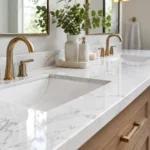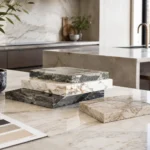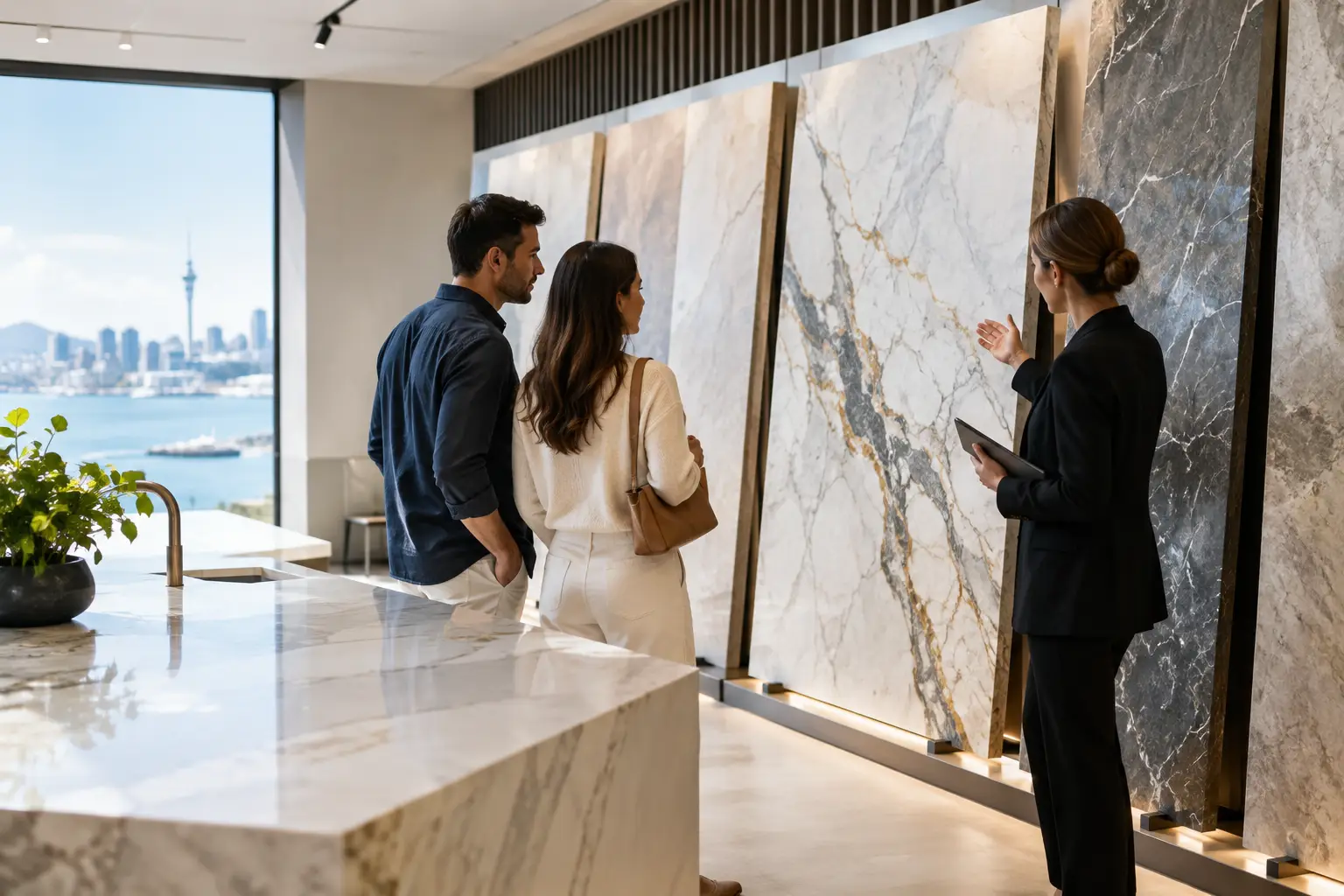
A stone showroom appointment Auckland clients book is often the point where an idea becomes a material decision. A kitchen island may be drawn as a clean rectangle on a plan, but its character changes completely when a client sees the sweep of a quartzite vein, the depth of a dark granite, or the quiet translucency of onyx in person.
For design professionals and private clients alike, viewing stone should happen early enough to influence the wider interior. Natural stone is not a flat colour sample. It is an architectural material with movement, tonal shifts, texture and individual character. The right slab can inform cabinetry, joinery, lighting, wall finishes and even the balance of a room.
Why a stone showroom appointment in Auckland matters
Digital imagery is useful for building an initial direction, yet it cannot communicate scale, surface finish or natural variation with complete accuracy. A photograph may show the central vein of a slab, but not the quieter areas around it. It may suggest a warm white marble, while in person the material reveals grey, gold, olive or soft blue undertones that change with the light.
An appointment gives you time to view actual slabs at a useful scale and consider them in relation to the project. This matters especially where stone will be a focal point: a generous island, bookmatched feature wall, hospitality bar, vanity, fireplace surround or reception desk. These are not surfaces that disappear into the background. They establish a visual language for the space.
For architects and interior designers, an early showroom visit also helps avoid specifying a material purely from a small sample. The selection can then be developed around available slabs, intended applications and the level of natural movement the design can accommodate. For homeowners, it replaces uncertainty with a more personal response: the material either feels right for the home, or it does not.
Moonstone’s Auckland showroom is designed for this kind of considered selection. The focus is on hand-selected natural stone and premium quartz surfaces with distinctive character, viewed as materials for a specific space rather than as interchangeable finishes.
Prepare for the visit, but leave room to be surprised
A showroom appointment is most productive when there is enough context to guide the conversation. You do not need every finish finalised. In fact, stone can be the material that helps settle the rest of the palette. But bringing a few key details allows the selection to move beyond broad preference.
Bring plans or approximate dimensions, particularly for benchtops, islands, vanities, wall cladding and larger architectural elements. Elevations are valuable where vein direction, joins or bookmatching may shape the final composition. Images of cabinetry, flooring, paint, tapware and surrounding finishes are equally useful, even if they are preliminary.
It also helps to arrive with a clear sense of the atmosphere you are seeking. Perhaps the brief calls for a calm, mineral palette with restrained movement. Perhaps it needs an exotic focal point with dramatic veining. Both directions can be appropriate, but they lead to very different materials.
Before the appointment, consider these practical questions:
- Which surface will carry the most visual weight in the room?
- Is the stone intended to contrast with cabinetry or sit quietly within a tonal scheme?
- Will the material continue across a splashback, wall or vertical face?
- Is the project looking for the individuality of natural stone, the consistency of engineered quartz, or a considered combination of both?
These are not rules that need firm answers before you arrive. They are prompts that make it easier to assess each slab with intention.
Think in full slabs, not sample squares
A small sample can tell you about a base colour and finish. It cannot show how a large quartzite vein travels across an island, where a marble clouding becomes more pronounced, or how a granite’s crystalline detail reads from across a room.
When viewing a slab, step back first. Notice its overall composition and the areas of movement that will be most visible at architectural scale. Then move closer and look at the finer grain, natural fissures, tonal shifts and texture. A material can feel composed from a distance but richly detailed up close, which is often what gives a room lasting interest.
It is also worth asking where key cuts may sit. The centre of an island, for example, may call for the most expressive section of a slab, while a return, side panel or smaller vanity may suit a quieter area. This is why the slab itself should be part of the design conversation, not a late-stage procurement item.
Natural variation is part of the material story
Rare natural stone is valued precisely because it is not uniform. Marble, quartzite, granite and onyx are formed over time through geological processes that produce variation in colour, veining, mineral deposits and pattern. Two slabs from the same family can be closely related while still having distinct personalities.
For a design-led project, this variation is often the point. A striking vein can give a kitchen island a sense of movement. A quieter slab may bring depth to a restrained bathroom. A richly coloured stone can make a commercial interior feel grounded and memorable without relying on excessive decoration.
That said, the most visually dramatic material is not automatically right for every setting. A heavily veined stone can be exceptional on a single statement island, yet compete with detailed cabinetry, patterned tiles or strong timber grain. Conversely, a more subtle material may allow sculptural joinery or artwork to take precedence. The decision depends on what the stone needs to do within the overall composition.
Engineered quartz offers a different design pathway. It can be a compelling choice where a more consistent appearance supports the brief, while selected natural stone introduces singular character in feature applications. There is no need to frame one as a substitute for the other. The question is how each material contributes to the project.
Use the appointment to test the wider palette
Stone rarely lives alone. During a showroom appointment, place physical samples beside the slabs where possible. Timber, porcelain, metal finishes, paint cards and upholstery can reveal relationships that are difficult to judge separately.
Pay particular attention to undertones. A pale slab may carry warmth that complements oak but makes a cool grey cabinet appear blue. A dark stone may contain fine bronze or green mineral notes that connect beautifully with aged metalwork. These quieter links are often what make an interior feel resolved rather than simply coordinated.
Lighting deserves equal attention. Stone can look noticeably different beneath warm decorative lighting, neutral task lighting and daylight. If a project includes a feature wall or translucent material, discuss how the intended lighting approach may influence the final effect. The aim is not to predict every condition perfectly, but to make a selection with eyes open.
For hospitality and commercial projects, consider viewing distance and repetition as well. A stone that feels beautifully detailed at a vanity may read differently across a long bar front or expansive reception surface. Slab quantities, continuity of movement and the placement of joins should be considered as part of the architectural intent.
Questions worth asking in the showroom
A good appointment should feel like a focused material conversation, not a rushed selection exercise. Ask which slabs are currently available for the project, how their visual characteristics differ, and whether the quantity supports the intended scale of application.
If the material will appear across multiple planes, ask how the movement could be oriented and where the most expressive areas may be positioned. Discuss the finish of the stone and how it suits the desired look. A polished surface can emphasise colour and depth, while other finishes may create a more tactile, understated expression.
It is also useful to be direct about the realities of the brief. If the project has a fixed programme, a defined material allowance or several decision-makers, say so early. This helps the selection remain both aspirational and commercially practical. Exceptional material is most successful when its visual potential and project requirements are considered together.
Give the selection the attention it deserves
The best showroom visits allow enough time for first impressions to settle. A slab that seems bold at first may become the natural centrepiece once paired with the right cabinetry sample. Another that looks understated alone may reveal remarkable depth beside complementary finishes.
For Auckland clients, the showroom at 6/273 Neilson Street, Onehunga provides the opportunity to view actual slabs before committing them to a project. For projects elsewhere in New Zealand, an appointment can also establish a clear material direction before supply is coordinated.
Choose the stone that continues to hold your attention after the initial impact. That is often the material with the depth, character and presence to make the finished space feel genuinely its own.