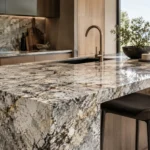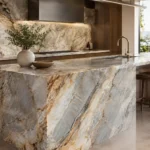
A natural stone supplier does more than provide a surface for a benchtop, vanity or wall. The right supplier helps a project begin with material that has presence: a marble with fine, architectural veining, a quartzite with remarkable depth, or an onyx selected for its light-catching translucency. For design-led spaces, that difference is felt long after the plans are approved.
Natural stone is not a uniform product. Every block, slab and finish carries its own colour, movement and geological character. Selecting it well requires more than choosing a name from a sample board. It calls for a considered view of the actual material, an understanding of where it will sit within the design, and practical coordination around quantities, timing and intended use.
Start with the stone, not just the surface category
“Marble”, “granite” and “quartzite” are useful starting points, but they do not tell the whole story. Within each category, the visual range can be vast. One marble may be quiet and cloud-like; another may have bold veining that becomes the focal point of a room. A quartzite may read as understated from a distance, then reveal layers of mineral colour and crystalline detail up close.
A considered natural stone supplier will help you look beyond broad labels and towards the individual slab. This is particularly important when the stone is intended to carry the design, such as on a large island, full-height splashback, fireplace surround, hospitality bar or feature wall.
The most successful selection is rarely made in isolation. Consider the stone alongside joinery colour, flooring, metal finishes, natural light and the scale of the room. A dramatic slab can be extraordinary in a generous, light-filled kitchen, yet feel too visually active in a smaller space with already expressive cabinetry. Equally, a restrained stone can bring balance where the architecture is doing more of the talking.
Why viewing actual slabs matters
Small samples are helpful for narrowing a palette, but they cannot communicate the full composition of natural stone. Veins change direction. Colour shifts across the face of a slab. Areas of movement that seem subtle in a sample may become defining when spread across a kitchen island.
Viewing the actual slabs allows designers and clients to make choices with confidence. It offers the opportunity to assess the overall field of colour, identify the most compelling areas of movement and think about how the material may be laid out across a finished surface.
This matters especially where multiple slabs are required. A project may need visual continuity across a benchtop, splashback and adjoining wall, or it may deliberately celebrate variation between zones. Neither approach is automatically better. What matters is that the selection supports the architectural intent.
A showroom-led process also creates space for better conversations. Rather than making a rushed decision from a screen, clients can see the stone in person, compare options and discuss the role it needs to play within the wider scheme.
Natural variation is part of the value
Natural variation should be understood as a feature of genuine stone, not a flaw to be designed around reluctantly. Mineral deposits, veining, fossils, crystalline structures and tonal shifts are the record of how the material formed. They give each slab its individuality.
That individuality does require clear expectations. A stone selected from a photograph alone may look different under another light source or when viewed at full scale. The best process is transparent from the beginning: inspect the material, discuss its character openly and select slabs that feel right for the space.
For clients seeking a more consistent appearance, certain stones and selected engineered quartz surfaces may be better suited to the brief. For those drawn to rarity, movement and a sense of permanence, natural stone offers a depth that cannot be repeated exactly.
Look for project-focused guidance
A supplier should be able to discuss the practical context of the material without reducing the decision to a technical checklist. A family kitchen, a private ensuite, a hotel reception and a commercial dining space each place different demands on a surface and invite different design opportunities.
It is useful to arrive with a few project details: indicative measurements, drawings if available, images of the intended interior direction and a sense of the surfaces being considered. This gives the conversation a foundation. It also helps establish whether the stone is best suited to a benchtop, wall cladding, vanity, island, fireplace or another architectural application.
There are always trade-offs. A highly expressive stone may need considered slab planning so its strongest movement is positioned where it will have the greatest impact. A pale marble can bring softness and elegance, while also calling for an honest conversation about the lived-in character that natural materials can develop over time. A darker granite may offer a more grounded visual effect, but its pattern and finish should still be assessed against the room’s light levels.
Good guidance is not about steering every project towards the same material. It is about helping clients and specifiers choose with clarity.
Consider supply, scale and timing early
Exceptional materials are often selected for a particular project because they are distinctive. That can make early decision-making valuable, particularly when a design relies on a specific colourway, slab pairing or quantity.
Before committing to a stone, confirm that the available slabs suit the required area and intended layout. A large island or a full-height wall may need more material than expected once allowances are considered. Where continuity is important, it is worth discussing the number of slabs needed before the design is finalised.
Timing matters too. Material selection should sit early enough in the programme to inform joinery, fixture and architectural decisions. Leaving stone until the end can narrow the choices unnecessarily or force a compromise between the preferred material and the available quantity.
For professionals managing several moving parts, clear communication around slab availability, project requirements and collection coordination is as important as visual appeal. The material may be rare, but the process should still feel considered and reliable.
Choose a supplier with a curatorial eye
Not every project needs the most dramatic stone in the room. However, every project benefits from material selected with intention. A supplier’s collection should demonstrate an eye for colour, movement, texture and the ways stone can shape an interior.
At Moonstone, the focus is on hand-selected rare natural stone and premium quartz surfaces chosen for their distinctive character. The Auckland showroom provides architects, designers, fabricators, builders and private clients with the chance to view actual slabs and select material for projects throughout New Zealand.
A curated collection is not simply about rarity for its own sake. It gives a designer more meaningful options: a quiet limestone-toned surface for a calm interior, a deeply veined marble for a statement island, or an exotic quartzite that brings natural drama to a hospitality setting. The point is not to make every space louder. It is to find the material that makes the space feel complete.
Questions worth asking before selection
The strongest material decisions are made when visual ambition and practical information meet. Before selecting, ask whether the slabs being viewed are the actual slabs allocated to the project, whether there is sufficient quantity for the planned application, and how the stone’s variation will read across the finished scale.
It is also sensible to discuss finish, edge details and the relationship between adjoining surfaces. These details influence how stone is perceived. A honed finish can create a softer, more tactile impression, while a polished surface may heighten colour and reflectivity. The right choice depends on the design language, lighting and intended use.
Finally, ask whether the material feels personal to the project. The most memorable interiors are not built from generic selections. They are shaped by choices that belong to the architecture, the setting and the people who will use the space.
A beautiful slab deserves time in front of it. When you can stand back, see its full movement and imagine it becoming part of a room, selection becomes less about buying a surface and more about choosing an enduring architectural material.